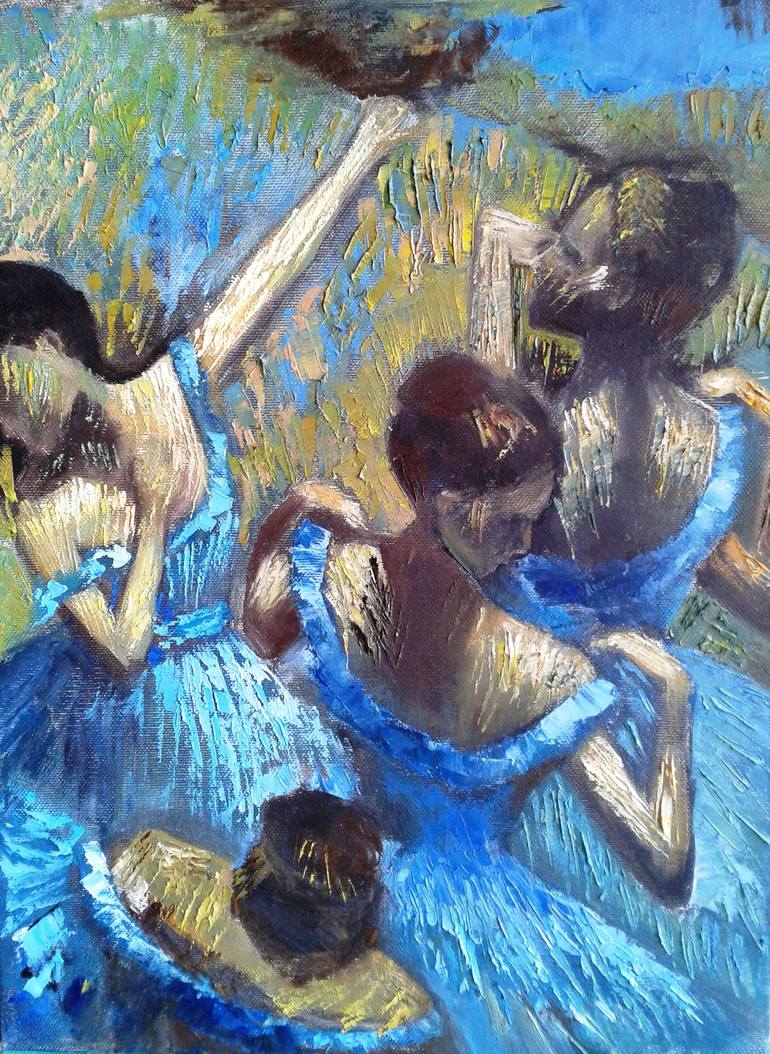
It’s the birthday of Edgar Degas (1834), the French Impressionist painter best known for his studies of female dancers, like The Dancing Class (1871) and The Dance Class (1874). In 1880, his sculpture The Little Fourteen-Year-Old Dancer was exhibited, but drew criticism for its realism, with some critics deeming it “ugly.” Degas had dressed his dancer in a cloth tutu and given her real hair. He never exhibited any sculpture in public again during his lifetime.
Degas was born in Paris. His father was a banker and his mother an amateur opera singer from New Orleans. He was a precociously talented child, but when he came of age, his father urged him to attend law school, which Degas did, though he didn’t apply himself to his studies and soon left to study at the École des Beaux Arts. He also received permission to “copy” at the Louvre in Paris, a common practice for aspiring artists in the 19th century, who would gather to draw from works by Raphael and Delacroix. Degas met the artist Ingres, who told him, “Draw lines, young man, and still more lines, both from life and memory, and you will become a good artist.”
By 1862, he’d befriended fellow painter Edward Manet and been rejected by the prestigious Salon, the official art exhibition of the Académie des Beaux-Arts in Paris, which found his work unfinished and hasty. Degas favored interesting angles for his subjects, which may have been due to his poor eyesight. He said: “No art was ever less spontaneous than mine. What I do is the result of reflection and of the study of the great masters; of inspiration, spontaneity, temperament, I know nothing.” He joined with other outsider artists to exhibit work on their own, but he was irascible, mocking Monet for painting outdoors.
Degas continued to paint ballet dancers because it earned him the most money. His anti-Semitism became virulent as he aged, though, which cost him friends and commissions. Auguste Renoir said: “What a creature he was, that Degas! All his friends had to leave him; I was one of the last to go, but even I couldn’t stay until the end.”
In his last years, nearly blind, Degas stopped painting and took to wandering the streets of Paris. He died when he was 83. After his death, acquaintances found more than 150 wax sculptures in his studio. The original sculpture of The Little Fourteen-Year-Old Dancer has since been cast in bronze.
Edgar Degas said, “If painting weren’t so difficult, it wouldn’t be so much fun.”
Cinderella’s Diary
by Ron Koertge
I miss my stepmother. What a thing to say,
but it’s true. The prince is so boring: four
hours to dress and then the cheering throngs.
Again. The page who holds the door is cute
enough to eat. Where is he once Mr. Charming
kisses my forehead goodnight?
Every morning I gaze out a casement window
at the hunters, dark men with blood on their
boots who joke and mount, their black trousers
straining, rough beards, calloused hands, selfish,
abrupt…
Oh, dear diary—I am lost in ever after:
those insufferable birds, someone in every
room with a lute,
the queen calling me to look
at another painting of her son, this time
holding the transparent slipper I wish
I’d never seen.
“Cinderella’s Diary” by Ron Koertge from Vampire Planet. © Red Hen Press, 2016.
TUESDAY, JULY 19, 2022
“Let us help one another to be leaven in the dough of this world. Together we can and must continue to care for human life, the protection of creation, the dignity of work, the problems of families, the treatment of the elderly and all those who are abandoned, rejected or treated with contempt. In a word, we are called to be a Church that promotes the culture of care, tenderness and compassion towards the vulnerable. A Church that fights all forms of corruption and decay, including those of our cities and the places we frequent, so that in the life of every people the joy of the Gospel may shine forth. This is our “fight”, and this is our challenge. The temptation to stand still is great; the temptation of that nostalgia which makes us look to look at other times as better. May we not fall into the temptation of “looking back” which is becoming fashionable today in the Church.”
Pope Francis


 The Vibrant Channeled Creator