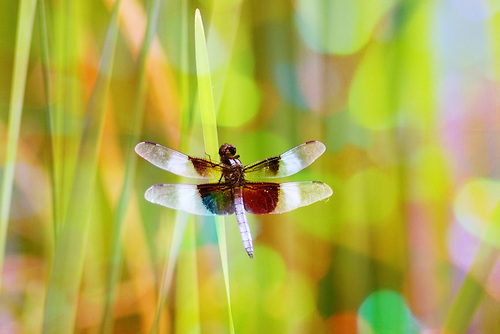
The Dragonfly
by Louise Bogan
You are made of almost nothing
But of enough
To be great eyes
And diaphanous double vans;
To be ceaseless movement,
Unending hunger,
Grappling love.
Link between water and air,
Earth repels you.
Light touches you only to shift into iridescence
Upon your body and wings.
Twice-born, predator
You split into the heat.
Swift beyond calculation or capture
You dart into the shadow
Which consumes you.
You rocket into the day.
But at last, when the wind flattens the grasses,
For you, the design and purpose stop.
And you fall
With the other husks of summer.
“The Dragonfly” by Louise Bogan, from The Blue Estuaries: Poems 1923-1968. © Farrar, Straus and Giroux, 1995. Reprinted with permission.
Andre Dubus II’s books include Adultery and Other Choices (1977), Finding a Girl in America (1980), The Times are Never So Bad (1983), The Last Worthless Evening (1986), and Dancing After Hours (1996). His story “Killings” was adapted into the film In the Bedroom (2001).
Dubus said: “A first book is a treasure, and all these truths and quasi-truths I have written about publishing are finally ephemeral. An older writer knows what a younger one has not yet learned. What is demanding and fulfilling is writing a single word, trying to write le mot juste, as Flaubert said; writing several of them which becomes a sentence. When a writer does that, day after day, working alone with little encouragement, often with discouragement flowing in the writer’s own blood, and with the occasional rush of excitement that empties oneself, so that the self is for minutes or longer in harmony with eternal astonishments and visions of truth, right there on the page on the desk; and when a writer does this work steadily enough to complete a manuscript long enough to be a book, the treasure is on the desk. If the manuscript itself, mailed out to the world where other truths prevail, is never published, the writer will suffer bitterness, sorrow, anger, and, more dangerously, despair, convinced that the work was not worthy, so not worth those days at the desk. But the writer who endures and keeps working will finally know that writing the book was something hard and glorious, for at the desk a writer must try to be free of prejudice, meanness of spirit, pettiness, and hatred; strive to be a better human being than the writer normally is, and to do this through concentration on a single word, and then another, and another. This is splendid work, as worthy and demanding as any, and the will and resilience to do it are good for the writer’s soul. If the work is not published, or is published for little money and less public attention, it remains a spiritual, mental, and physical achievement; and if, in public, it is the widow’s mite, it is also, like the widow, more blessed.”


 The Vibrant Channeled Creator