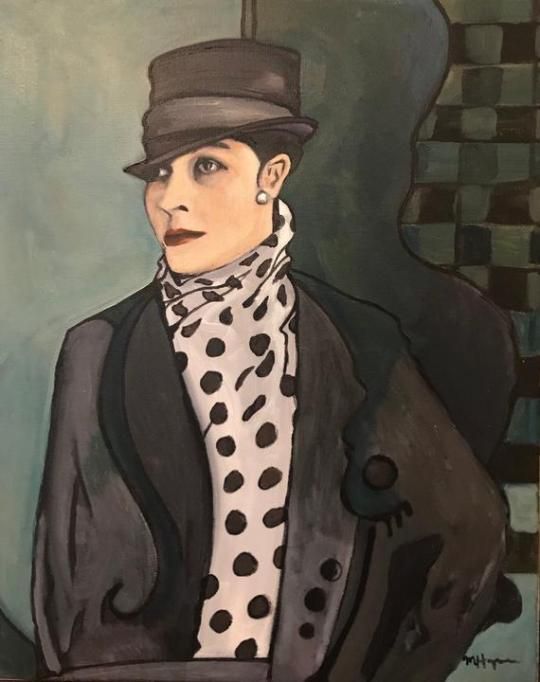
Djuna Barnes
From Garrison Keillor and The Writer’s Almanac on June 12th 2024
It’s the birthday of Djuna Barnes, born in Cornwall-on-Hudson, New York (1892). She started out as a reporter for a variety of different magazines, including Vanity Fair and The New Yorker, and she often contributed illustrations for her own articles. She was part of the bohemian scene in Greenwich Village, and published a collection of poems and drawings in 1915 called The Book of Repulsive Women.
She moved to Paris in 1920 and became friends with writers there, including T.S. Eliot, Gertrude Stein, and James Joyce. After reading Joyce’s novel Ulysses in 1922, she said: “I shall never write another line. Who has the nerve to after that?” But almost 15 years later, she published Nightwood (1936), an experimental novel about a woman named Nora Flood, her love affairs and her spiritual advisor, a transvestite named Dr. O’Conner.
The book was rejected by all the American publishers she submitted it to, but T.S. Eliot loved it, so he published it himself and wrote an introduction. It had a great influence on many later experimental writers of the 1950s and ’60s, and it’s become a cult favorite.
For the last 42 years of her life, Barnes lived as a recluse in New York City. Writers came to pay homage to her, including Bertha Harris and Carson McCullers, but she sent them away. Her neighbor E.E. Cummings used to check on her by yelling out his window. She rarely left her house, and she spent her last 30 years working on a long poem that was found in her apartment when she died in 1982. In 1973, she told her editor Douglas Messerli: “It’s terrible to outlive your own generation.”


 The Vibrant Channeled Creator