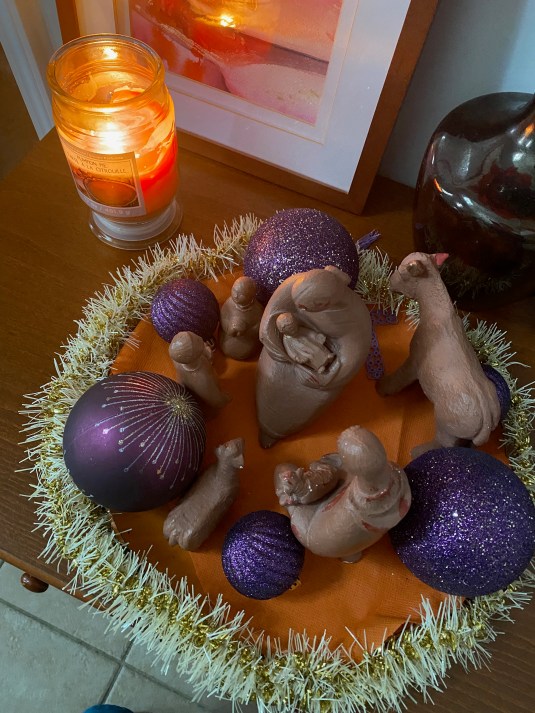
Incarnation: flesh infant in Bethlehem
The Mystical Body of Christ

Jesus Lord in His Glory
Jesus the Lord comes in glory to take His righteous humans with Him!
Jeanne Poland's Poetry Blog
02 Dec 2024 1 Comment
in Poetry Tags: Advent, expectation, incarnation, infant in Bethlehem, Mystical Body of Christ, waiting
Incarnation: flesh infant in Bethlehem
The Mystical Body of Christ
Jesus Lord in His Glory
Jesus the Lord comes in glory to take His righteous humans with Him!


 The Vibrant Channeled Creator
Dec 03, 2024 @ 03:20:51
What is a religious Zionist response to Kesuvos 111a? As a religious Zionists, strongly support the state of Israel. While ultra Orthodox often oppose the Jewish state ie Jewish self-determination to rule our Homeland in the Middle East. How should Zionist Jews respond to Haredim who quote this passage?
Hasidim and Lithuanian Haredim anti-Zionist Haredim believe that the existence of a Jewish state prior to the Messianic era is a violation of the Three Oaths. They believe that voting in Israeli elections causes one to become a “partner” in all the sins committed by the government, which includes enabling it to violate the Three Oaths.
The overarching motive behind many Haredim’s opposition to Zionism stems from a traditional and religious view of Jewish identity and peoplehood which runs counter to Zionism’s nationalist ideology. Haredim often cite the 10th-century rabbinic sage Rav Saadia Goan as spelling out their national identity in terms irreconcilable with modern nationalism. The opposition extends to ancillary parts of Zionist ideology, such as militarism and organic nationalism, which they hold are incongruous with Jewish religious teachings.
Historically, many dynasties in Hasidism have expressed anti-Zionist opinions because of the “Three Oaths”. The Talmud, in Ketubot 111a, mentions that the Jewish people have been bound by three oaths: 1) not to ascend to Eretz Yisrael (the Land of Israel) as a group using force; 2) not to rebel against the nations of the world; and 3) that the nations of the world would not persecute the nation of Israel excessively. Some consider the establishment of the State of Israel to be a violation of these oaths. The first Haredi anti-Zionist movement was Agudath Israel, established in Poland in 1912. Haredi groups and people actively and publicly opposing Zionism are Satmar, Toldos Aharon, Neturei Karta.
Lithuanian Haredim, sometimes called mitnagdim, take a different approach to their beliefs from their Hassidic counterparts. Lithuanian religious Jews oppose the state not because of the three oaths midrash but because they feel that Zionism epitomizes secularity and Jewish desire to be void of Torah.
Amongst the Ashkenazi Orthodox rabbinical leadership, religious Zionists form a minority. Generally speaking, most Sephardi Haredi authorities have never shared the anti-Zionism of their Ashkenazi counterparts, and some (such as the late Rabbi Mordechai Eliyahu) are strongly affiliated with Religious Zionism, taking a similar stance to the Hardal movements. (The Religious Zionist Jewish community in Israel. These individuals combine elements of Haredi (ultra-Orthodox) ideology with a strong commitment to Zionism and the State of Israel). However, there are anti-Zionist elements in the Sephardi communities as well. It is known that the late Baba Sali supported and celebrated the anti-Zionist views of the Satmar Rebbe.
The relationship between Haredim and Zionism became more complex after the founding of the State of Israel in 1948. Some Haredi groups “with great reluctance permitted” being involved in the political process of the state by voting in elections and accepting state funding. They maintained that since the government is not an ideological Zionist organization (as is the WZO, for example), and also they are not voluntarily choosing to join the Zionists, but rather it is like a partnership that already exists – “and if one wouldn’t participate, the other partner would take over his rights as well.” Others have maintained a more hardline rejectionist position, refusing all funding from the Israeli state and abstaining from taking part in the political process.
The Agudat Israel is an international organization (with an Israeli association) of various Haredi groups, mainly from the Lithuanian yeshiva communities and Hasidic groups such as Ger and Belz. The Agudah was initially created as an umbrella organization of Orthodox Jews who were united to fight against the Zionist movement. Out of necessity and “to save from the mouth of the lion” they permitted participating in national elections and sending their representatives to the Israeli Knesset, “to actively protect what is holy to us.” They did not take full part in it by not serving in its military, and do not celebrate any of the State’s official holidays. They are adamantly opposed to serving in the military, because of the gilui arayos, shfichus damim (Shfichus Damim is one of the Three Cardinal Sins (Avirot HaMitzvot), along with Gilui Arayot (sexual immorality) and Avodah Zarah), and avodah zarah that exists. The Agudat Israel party in the Knesset is represented as United Torah Judaism, a collective party of Agudat Israel and Degel HaTorah. It tries to influence the Knesset with a pro-Judaism outlook, by mainly focusing on funding for Jewish education (yeshivas), exemption from military service for Haredi yeshiva students, and trying to safeguard basic rights such as freedom to practice their religion. In general, the Agudath Israel position is supportive of Israel.
A number of Lithuanian (non-Hasidic) leaders, like the Chazon Ish (1878–1953), Rav Shach (1898–2001), and Rabbi Yosef Sholom Elyashiv (1910-2012), have expressed strongly anti-Zionist views. Examples of this are found in lectures and letters of Rav Shach. One of the newspapers of the Litvish world, the Yated Neeman, regularly publishes articles strongly criticizing Zionism, naming it a “heretical movement”. The main Litvish community does vote, as per what many say were the instructions of the Chazon Ish. However, some of the Chazon Ish’s disciples dispute this claim. Rabbi Elyashiv would urge his followers to vote for the Degel HaTorah list. Rabbi Shimshon Dovid Pincus, quoted in the book of his speeches about Purim, explains that in each generation, the Yetzer Hara appears in different forms. Examples he gives are the Enlightenment and communism. He goes on to explain that nowadays, Zionism is a form of the Yetzer Hara.
Rabbi Moshe Feinstein (1895–1986), one of the American leaders of the Lithuanian Jewish world, writes in a responsum to a question whether it is permissible to pray in a synagogue which displays an Israeli flag: “Even though it is improper to bring the flags into shul, and all the more so not to keep them there permanently, and all the more so, not near the Aron Kodesh, and one should try to remove it peacefully. However, to make a fight over this is forbidden.”
The Soloveitchik dynasty of Lithuanian Haredi Judaism is known as one of the most elite scholastic dynasties in all of Orthodox Judaism. The dynasty split into two groups in the 20th century, as parts of the Soloveitchik Rabbinical family veered away from their anti-Zionist tradition set by Rabbi Chaim Soloveitchik of Brisk, and adopted views aligned with Modern Orthodox Judaism and Religious Zionism. Ironically, the Zionist faction of the Brisker dynasty is centered in the United States, and the anti-Zionist faction was, and continues to be, centered in Israel. Rabbi Meir Soloveitchik and Rabbi Dovid Soloveitchik, who lead two of the Brisker yeshivas in Jerusalem, continue to be outspoken opponents of Zionism.
While ideologically opposed to Zionism, the moderate Hasidic groups of Ger, Breslov, Vizhnitz, Belz, and Klausenberg do vote in the Israeli elections, and accept Israeli government funding. Ger and Belz are two of the most influential movements behind the Israeli political party Agudat Yisrael, which, together with the Lithuanian Degel HaTorah, forms the United Torah Judaism party. Prominent Gerrer rabbi, Yitzhak-Meir Levin, was a signatory to the Israeli Declaration of Independence. He also served as Minister of Welfare, though today, members of Agudat Israel prefer to serve as Deputy Ministers, or in Knesset Committees. These groups do not observe any days associated with the state, and neither do they recite the Prayer for the State of Israel.
The fifth Lubavitcher Rebbe, Rabbi Sholom Dovber Schneersohn (1860–1920), also known as the RaShaB, published Kuntres Uma’ayan, the beginning of which contains a strong polemic against secular Zionism. He was deeply concerned that secular nationalism would replace Judaism as the foundation of Jewish identity.
Post Shoah, the Goyim profaned the 3 vows. Furthermore, possible to annul a vow. In the case of Rabbi Zeira’s interpretation, the concept of not ascending as a wall until the appointed time could indeed be seen as a vow—an individual commitment to patience and waiting for the right moment.
The pursuit of justice is a fundamental theme in Judaism. The Moshiach is often associated with the establishment of a just and righteous society. Post-Holocaust (Shoah), the need for justice and healing became even more pronounced. The horrors of the Holocaust underscored the urgency of seeking justice, both for the victims and for humanity as a whole.
The return to the Land of Israel after the Babylonian exile serves as a historical precedent—a reminder that even in the darkest times, redemption is possible. Discussions about the Moshiach, justice, and redemption are multifaceted and often evoke deep emotions. The 40 year Wilderness g’lut of the Wilderness generation, which according to Rabbi Akiva: has no portion in the world to come, for its failure to rise up: invade and conquer Canaan mirrors the Orthodox rabbanut of the pre-WWII Europe who denounced Zionism and refused to rise up to move in mass to British Palestine prior to the window of opportunity closed with the passages of the second White Paper in 1939.
Rabbi Akiva’s perspective on the Wilderness generation’s lack of faith echoes the debate within European Jewry about the role of Zionism and the balance between spiritual and national aspirations. The pursuit of justice is a moral imperative in Judaism. The horrors of the Holocaust underscored the urgency of seeking justice for the victims, their families, and humanity as a whole. Rabbi Akiva’s perspective on the Wilderness generation’s lack of faith resonates with the debates within European Jewry about Zionism. The balance between spiritual aspirations and national identity was indeed a complex struggle.
The refusal to rise up and move en masse to British Palestine before the window closed with the Second White Paper in 1939 reflects the tension between pragmatic considerations and spiritual yearning. The mitzva of Moshiach, defined as the dedication to pursue justice: ie fair judicial compensation of damages inflicted upon victimes by the wicked, within the borders of the oath sworn lands of Israel. The confusion how rabbinic Judaism learns Kesuvos 111a as oaths rather than vows stands in stark contrast to the 3 oaths whereby Avraham Yitzak and Yaacov swore to cut an eternal brit with HaShem for the chosen Cohen seed to eternally inherit the oath sworn by HaShem to the Avot for this chosen Cohen seed to eternally inherit the lands of Canaan.
The three oaths mentioned in the Gemara are fundamentally different from the oaths that are sworn before a Torah scroll. The distinction between a Torah oath (which carries specific legal and moral implications) and a vow (which may be more personal or situational) is indeed significant. Understanding the context in which these oaths were taken is essential. These oaths reflect a commitment to restraint and patience during exile rather than a formal legal obligation that would accompany a Torah oath. This nuance is critical to avoiding confusion between the two. This matter highlights the importance of precise language and context in Talmudic study, ensuring a deeper and more accurate understanding of these foundational concepts.
The text primarily refers to three oaths that a husband may take regarding his financial obligations or claims against his wife. These oaths relate to different aspects of marital obligations, particularly concerning the husband’s claims about the ketubah (marriage contract) and other financial matters. The distinction between oaths and vows is significant in Jewish law, as they carry different implications and requirements.
In Kesuvos 111a, the discussion revolves around the concept of oaths (shevuos) and vows (nedarim). The text addresses the different circumstances under which a husband may be required to take oaths regarding his wife’s ketubah, particularly concerning the financial obligations he has towards her. In Kesuvos 111a, the discussion revolves around the oaths (sh’vuos) that a husband may take regarding his wife’s claims. The text typically refers to three oaths that the husband swears: An oath regarding the claims she has made against him. An oath that he has not withheld her ketubah (marriage contract). An oath that he has not committed any sin that would affect her rights.
The distinction is important because oaths generally pertain to affirmations of truthfulness or commitments, while vows involve specific prohibitions or commitments to perform certain actions. In this context, it is significant to understand the implications of each in terms of marital obligations and the legal framework governing them. The strongest proof that Kesuvos 111a refers to vows and not oaths – Yom Kippur. On Yom Kippur HaShem annulled his vow to make of the seed of Moshe the chosen Cohen nation. Moshe cause HaShem to remember the oaths HaShem swore to the Avot, which cause HaShem on Yom Kippur to do t’shuva and annul the Divine Vow to obliterate the people of Israel following the sin of the Golden Calf.
The oaths of the Patriarchs (Abraham, Isaac, Jacob) and the oaths in Kesuvos 111a is also problematic. These are vastly different contexts. The Patriarchal oaths concern a oath brit cut between the HaShem and the Avot regarding land inheritance and the chosen Cohen people. The oaths in Kesuvos 111a concern marital financial disputes. They simply do not compare to the oaths which the Avot each swore to cut a brit concerning the eternal inheritance of the lands of Canaan to the chosen Cohen nation.
Same equally applies to the argument touching Yom Kippur. HaShem annulled a vow (to destroy the Israelites after the Golden Calf). This, however, does not directly prove Kesuvos 111a’s oaths qualify in fact as vows. God’s actions utterly Big Picture unique. They do not automatically set a precedent for all lessor types of oaths not sworn while holding a Sefer Torah. The “oaths” issue which Kesuvos 111a addresses – specific to marital disputes and their annulment would have different implications. The context of the oaths within a legal framework of marital obligations strongly suggests they are oaths concerning truthfulness and financial responsibility, not vows concerning future actions.
Hence the mitzva of קידושין a Man acquires the O’lam Ha’Bah soul of his wife. Meaning the Man acquires Title to the future born seed this marital union shall produce in the future. Based upon the precedent of the oath brit cut between the pieces where HaShem swore an oath to Avram that his future born seed would number the stars of the Heavens for multitude. Avram, at the time of this Divine oath, childless.
Get/divorce aligns with mamzerim. Where a foreign man through adultery causes that woman to conceive a child. Therefore the mitzva of Get reverses the oath sworn at קידושין, by which a man acquires Title to all future born seed born consequent to this marital union. Based upon the Torah mitzva: fruitful and multiply. Hence, based upon this בנין אב/precedent the oath sworn on dof 111a of Kesuvos resembles a vow that a beit din can later annul.
A key understanding in point of law. A wicked man who refuses to give his ex-wife her get, therein profaning the oath sworn during the mitzva of קידושין, later a beit din and place this man into נידוי, based upon making a דיוק upon the precedent of ger tzedek as a new creation. Retroactively, at the moment of קידושין that Jew would not in point of fact be Jewish! Therefore the beit din could issue the get to the chained ex wife – based upon the precedent of 7th year fruit prozbul.
The oaths in Kesuvos 111a primarily pertain to marital financial obligations. They are serious commitments regarding truthfulness and accountability between spouses. If understood as legal oaths rather than personal vows, their negation would require a significant shift in legal interpretation. In Jewish eschatology, Moshiach, often associated with the redemption of Israel and the establishment of justice. The idea of Moshiach bringing about a new era could suggest a transformation of existing laws or obligations. However, whether this entails negating specific oaths equally debatable.
Theological discussions often involve divine intervention, redefining norms, and transcending human limitations. In this context, one might argue that the Moshiach’s arrival could indeed alter our understanding of obligations. From a legal standpoint, clear authority or prophetic mandate is necessary to annul Torah oaths. This aligns with the meticulous approach of halacha.
Indeed, discussions about the Messianic age often blend theology, hope, and imagination. Some envision a transformative era where the very fabric of reality shifts, rendering old norms obsolete. It’s like a cosmic remix—a spiritual remix, if you will. The legal mechanisms, the fine print. Torah oaths, like stubborn knots, don’t unravel easily. They’re woven into the fabric of our tradition, and untangling them requires more than mystical musings. Sometimes, the mystical and the practical collide, and we’re left with a delightful mishmash of tradition, hope, and a dash of skepticism.
While a mystical Moshiach might be envisioned as having the ability to change the dynamics of spiritual and legal commitments, the practical annulment of the oaths in Kesuvos 111a would depend on a broader consensus within the Jewish legal tradition. The interplay between law, theology, and mysticism creates a complex landscape for this discussion.
Religious Zionists emphasize the importance of the Land of Israel as integral to Jewish identity and destiny. When discussing Kesuvos 111a, it’s crucial to recognize that the oaths mentioned pertain to marital obligations rather than national aspirations. This distinction underscores a broader understanding of Jewish law that can coexist with the Zionist vision.
When Haredim cite Kesuvos 111a in opposition to Zionism, a religious Zionist response: Emphasize the distinction between the oaths in the Talmud, which address individual marital obligations, and the collective national aspirations of the Jewish people. Argue that the establishment of Israel, not a violation of the oaths but rather the fulfillment of the Jewish people’s oath brit with HaShem. The return to the land a crucial step towards the eventual coming of Moshiach and the restoration of justice. Articulate a vision where religious Zionism emphasizes the importance of spiritual and national identities coalescing. This vision includes advocating for a just society that embodies the Written Torah as the Constitution of the Republic and the Talmud as the working model to restore lateral Sanhedrin common law Courts in the Cities of Refuge within the border cities of the Jewish State.
What is a religious Zionist response to Kesuvos 111a? As a religious Zionists, strongly support the state of Israel. While ultra Orthodox often oppose the Jewish state ie Jewish self-determination to rule our Homeland in the Middle East. How should Zionist Jews respond to Haredim who quote this passage? Answer: This argument represents self-hating kapo Jews who make a dog chasing its tail circular argument of absolute narishkeit.
LikeLike