
when the sun shines
Jeanne Poland's Poetry Blog
16 Jan 2021 Leave a comment
in Poetry Tags: a dollar in the pocket of a winter coat in summer, a golden filamintinscribed with the name of God, bearing beautiful gifts, forRay..., garden in the air, I am the discoverer of you, Jonathan Potter, when the sun shines, You and I, you are a warm front
when the sun shines
15 Jan 2021 Leave a comment
in Poetry Tags: EllaWheeler Wilcox, frieve, glad, joyful, laugh, lordly, mirth, narrow, pleasure, rejoice, sad old earth, shrink, sigh, sing, solitude, weep, woe

Solitude
by Ella Wheeler Wilcox
Laugh, and the world laughs with you;
Weep, and you weep alone;
For the sad old earth must borrow its mirth,
But has trouble enough of its own.
Sing, and the hills will answer;
Sigh, it is lost on the air;
The echoes bound to a joyful sound,
But shrink from voicing care.
Rejoice, and men will seek you;
Grieve, and they turn and go;
They want full measure of all your pleasure,
But they do not need your woe.
Be glad, and your friends are many;
Be sad, and you lose them all,
— There are none to decline your nectared wine,
But alone you must drink life’s gall.
Feast, and your halls are crowded;
Fast, and the world goes by.
Succeed and give, and it helps you live
But no man can help you die.
There is room in the halls of pleasure
For a large and lordly train,
But one by one we must all file on
Through the narrow aisles of pain.
“Solitude” by Ella Wheeler Wilcox. Public Domain
14 Jan 2021 Leave a comment
in Poetry Tags: and listen, Bend low, Bend low and listen, friend, God of all, heavens and earth, high throne, Holy Spirit, Isaiah, O Lord, Open your eyes and see, quiet resources, save us, strengthen us, support group, you alone are God

sitting on your throne high above the angels
You alone are the God all the kingdoms of esrth
You created the heavens and the earth.
Bend low, O Lord, and listen.
Open your eyes, O Lord, and see.
O Lord, our God, we plead with you to save us from this power;
then all the kingdoms of this earth will know that you alone are God.
Isaiah
We may wish for an instant, miraculous deliverance of our problems, but it doesn’t usually happen that way. God most often uses quiet resources- the steady supply of a friend, the encouragement of a support group, the quiet leading of the Holy Spirit- to stregthen us in our recovery.
The Life Recovery Bible
13 Jan 2021 Leave a comment
in Poetry

On this day in 1968, country musician Johnny Cash recorded a live concert at Folsom Prison in California.
Back in the early 1950s, while serving in the Air Force and stationed in Germany, Cash had seen a documentary on life inside the prison. This inspired him to write the song “Folsom Prison Blues,” with its haunting lines, “I shot a man in Reno, just to watch him die.” He included it on his debut album, With His Hot and Blue Guitar, in 1957, and began dreaming of some day playing the song live for the inmates there. In 1968, after a personnel shake up at his recording label, Cash pitched the idea to a new producer who loved the idea.
Two concerts were recorded that day. Released just four months after the concert, Live at Folsom Prison reached No. 1 on the country charts and was a huge pop crossover.
Cash said: “You build on failure. You use it as a stepping stone. Close the door on the past. You don’t try to forget the mistakes, but you don’t dwell on it. You don’t let it have any of your energy, or any of your time, or any of your space.”
12 Jan 2021 Leave a comment
in Poetry Tags: $25 riches, brutal work, call of the wild, dangerous work, feisty teenager, Jack London, John Barleycorn, Klonedick, seal hinting expedition in the Bering Sea, South Sea Tales, taken in as an equal, White Fang, Writer's Almanac

from The Writer’s Almanac for Jan 12, 2021
11 Jan 2021 Leave a comment
in Poetry Tags: all rights, Alone in the Logan, in the fog, Jeanne/2001, silhouette alone, stands magestic, the empty hollow

the empty hollow
stands majestic in the fog
silhouette alone
All rights
Jeanne/2001
10 Jan 2021 Leave a comment
in Poetry Tags: Albany and Columbia Counties, asked for volunteers, Christ Church, Christ Church is requesting, delivering the covid vccine, emergency team, hundreds of thousands of shots, I will do any humanitarion work, Jeanne Poland, NY USA, release Dr. Grant, releasing him to serve in these trying times, serve as a volunteer, thank you, to quell the virus

The emergency team has asked for volunteers to administer hundreds of thousands of the shots to quell the exploding virus here in the states.
Thank you for releasing him to serve in these trying times.
Jeanne Poland,
and Christ Church
for Dr. Grant
09 Jan 2021 Leave a comment
in Poetry Tags: A Dutiful daughter, animated hand puppet, completely free, culture or society, culyure, existentialism, How I patch my chair, intellect, lived seo\parately, male and female, no interest in hygiene, no religion, not nature defines a woman, novelist, own existence, philosopher, shared works, Simone de Beauvoir, The Second Sex, worn spot, writer and artist

I have a worn spot on my chair
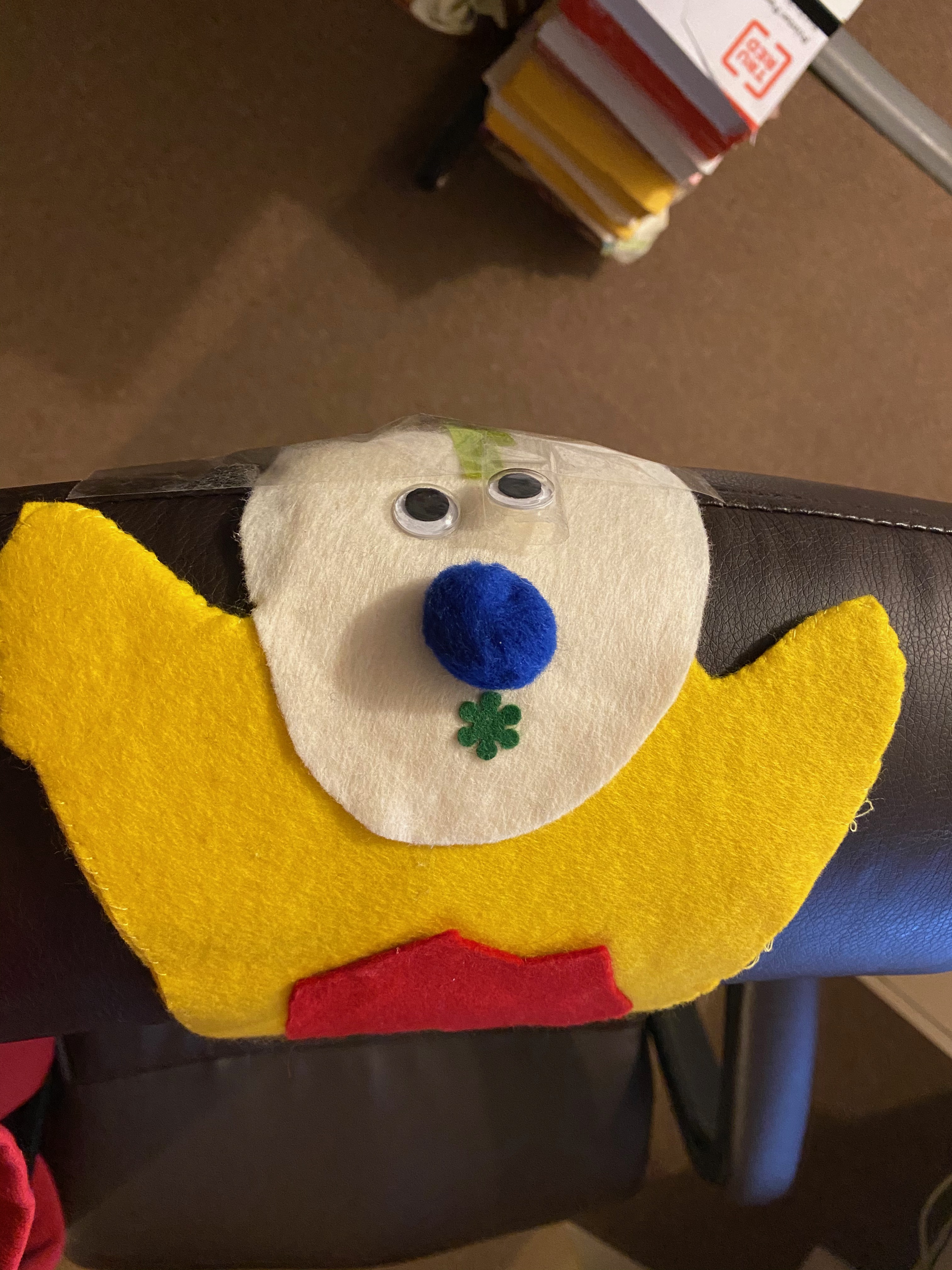
the patch I choose to cover it: a hand puppet made by an art student
Even my patches are animated portraits
I am like Simone de Beauvoir
A unique mixture of male and female
writer and artist
the novelist and philosopher Simone de Beauvoir (books by this author), born in Paris, France (1908).
She entered the Sorbonne, and it was there that she met another philosophy student, Jean-Paul Sartre. He was five feet tall, had lost his sight in one eye, wore baggy clothes, and seemed to have no interest in hygiene. But he loved to talk, and he was both funny and brilliant. Beauvoir later said, “It was the first time in my life that I felt intellectually inferior to anyone else.”
Sartre was equally impressed by Beauvoir’s intellect, especially when she finished her philosophy degree in one year, after it had taken Sartre three years to finish his own. She was the youngest person to receive the degree in French history. They fell in love, but instead of getting married, they decided to form a pact. They would both have affairs with other people, but they would tell each other everything. That basic arrangement of their relationship would last for the rest of their lives.
They didn’t even live together, but every evening they would meet in a café and show each other what they were working on. They each edited the other’s work, and they gave each other ideas, and together they helped formulate the school of philosophy known as existentialism, which was the idea that human beings should consider themselves completely free to define their own existence, without regard to religion, culture, or society.
Sartre wrote his book Being and Nothingness (1943) about the new philosophy, and Beauvoir followed with a book of ethics based on the same ideas, called The Ethics of Ambiguity (1947). But one of her most famous books was inspired by an offhand comment Sartre made one day. They were talking about the differences in the ways men and women were treated, and Beauvoir claimed that she’d never been adversely affected by this treatment. Sartre said, “All the same, you weren’t brought up the same way a boy would have been; you should look into it further.”
So Beauvoir did look into it. She spent weeks at the National Library in Paris researching the way women had been treated throughout history. The result was her book The Second Sex (1949), in which she wrote, “One is not born a woman, one becomes one.” It was one of the first comprehensive arguments that the difference between the sexes was the result of culture, not nature, and it helped found the modern feminist movement.
Beauvoir went on to write many more books, including several volumes of autobiography, such as Memoirs of a Dutiful Daughter (1958), about her childhood, and The Prime of Life (1960), which tells the story of her relationship with Sartre and the years they spent together during World War II.
07 Jan 2021 Leave a comment
in Poetry Tags: enwrought with golden and silver light, have my dreams, He wishes for the cloths of Heaven, heaven's embroided cloths, I am poor, night and light and half light, spread my dreams under your foot, The blue and the dim and the dark, tread softly because you tred on my dreams, under your feet, William Butler Yeats, You tred on my dreams

He Wishes for the Cloths of Heaven
by
William Butler Yeats
Had I the heavens’ embroidered cloths
, Enwrought with golden and silver light,
The blue and the dim and the dark cloths
Of night and light and the half-light, I
would spread the cloths under your feet:
But I, being poor, have only my dreams;
I have spread my dreams under your feet;
Tread softly because you tread on my dreams.
“He Wishes for the Cloths of Heaven
” by William Butler Yeats.
Public Domain
06 Jan 2021 Leave a comment
in Poetry Tags: American novelist, compassion, construct a conversation, ELDoctorow, held together, humanity, Jeanne's emoji, justify it, listen, listening, nature, Only you can tell your story, rediscovery of a sense of reverence for life, write a book without critique

And: “When you’re writing a book, you don’t really think about it critically. You don’t want to know too well what you’re doing. First, you write the book, then you find the justification for it. The book is constructed as a conversation, with someone doing most of the talking and someone doing most of the listening.”
American novelist E.L. Doctorow
American novelist E.L. Doctorow
He wrote: “Everything is held together with stories. That is all that is holding us together, stories and compassion.”
He said: “I’m not writing about nature. I’m writing about humanity. And if I have a subject, it is justice. And the rediscovery of the manifold way in which our lives can be shaped by the recovery of a sense of reverence for life.”


 The Vibrant Channeled Creator