dangerous woman

61441626_1990693161053772_5796364575645368320_o


It’s the birthday of the woman Teddy Roosevelt once called “the most dangerous woman in America” when she was 87 years old. Mary Harris Jones, or “Mother Jones,” (books by this author) was born to a tenant farmer in Cork, Ireland, in 1837. Her family fled the potato famine when she was just 10, resettling in Toronto. She trained to be a teacher and took a job in Memphis, where on the eve of the Civil War she married a union foundry worker and started a family. But in 1867, a yellow fever epidemic swept through the city, taking the lives of her husband and all four children. A widow at 30, she moved to Chicago and built a successful dressmaking business — only to lose everything in the Great Chicago Fire of 1871. Jones then threw herself into the city’s bustling labor movement, where she worked in obscurity for the next 20 years. By the turn of the century, she emerged as a charismatic speaker and one of the country’s leading labor organizers, co-founding the Industrial Workers of the World (IWW).
She traveled the country to wherever there was labor struggle, sometimes evading company security by wading the riverbed into town, earning her the nickname “The Miner’s Angel.” She used storytelling, the Bible, humor, and even coarse language to reach a crowd. She said: “I asked a man in prison once how he happened to be there and he said he had stolen a pair of shoes. I said if he had stolen a railroad, he would be a United States Senator.” Jones also had little patience for hesitation, volunteering to lead a strike “if there were no men present.” A passionate critic of child labor, she organized a children’s march from Philadelphia to the home of Theodore Roosevelt in Oyster Bay, New York with banners reading, “We want to go to school and not the mines!” At the age of 88, she published a first-person account of her time in the labor movement called The Autobiography of Mother Jones (1925). She died at the age of 93 and is buried at a miners’ cemetery in Mt. Olive, Illinois.
She said: “Whatever the fight, don’t be ladylike.”

present

37394270_1344637738972043_8097520525703643136_n

Time is the coin of your life.
It is the only coin you have,
and only you can determine how it will be spent,
Be careful lest you let other people spend it for you.
—CARL SANDBURG

Jazzy Ben Franklin


images

Jazz You’ll Never Know
by Margaret Hasse
Alex dresses up in a sweet black suit
for his Central High senior picture
holding his trumpet as if
he will raise it
like a silver night-blooming moonflower
to play “Sweet Georgia Brown” or “Almost Blue.”
Alex has sat in on jazz gigs in New Orleans,
San Francisco, D.C.
and Saint Paul.
He attends summer jazz camps, jazz competitions,
jazz schools,
listens to Smithsonian Jazz Orchestra records.
He once ate ice cream
named Jazz,
ate an apple
named Jazz,
hopes there’ll be a car
branded Jazz,
wears a cologne with notes
of jazzy fragrance from a blue bottle.
When he shakes his silver ID bracelet
his own name flashes on one side,
Louis Armstrong on the other.
Alex, I ask, what is it with you and jazz?
If you have to ask, Mom, he says, quoting his hero,
you’ll never know.
 
“Jazz You’ll Never Know” by Margaret Hasse from Earth’s Appetite. © Nodin Press, 2013. Reprinted with permission.

It was on this day in 1775 that the Continental Congress established the Postal System. In the early days of colonial America, there was no centralized system for transporting correspondence — merchants or slaves carried letters between towns, and taverns or inns collected overseas mail. Early American settlements were coastal and relatively isolated from each other. Most mail was transatlantic, going from colonists to friends or relatives back in Europe. Mail that needed to be transported within the colonies was carried by postal riders, who rode alone through dense wilderness, marking the way by slashing marks into trees with axes.

In 1707, the British Crown officially took over the North American postal system, and appointed a series of postmasters general. One of these was Benjamin Franklin, who worked hard to make the system more organized and efficient.

In January of 1774, Franklin was fired from his post for being sympathetic to the revolutionary cause. By that point, revolutionaries had set up alternative systems to deliver mail without the Crown’s knowledge. These systems were invaluable for secret correspondence, but also as a way to publicize revolutionary materials to a wider audience — otherwise, when the revolutionaries published anti-British newspapers and pamphlets, the Crown post simply refused to deliver them. Americans supported the alternative mail systems as one more way to boycott England — the Crown mail service came to be seen as a form of taxation. Soon, this alternative system became the more popular and profitable of the two.

In May of 1775, the Second Continental Congress formed a committee to determine the best way of organizing this new alternative system. The six committee members, including Franklin and Samuel Adams, spent two months deliberating, and delivered a report on July 25th. The following day — on this day in 1775 — it was approved by the Congress, and the Postal System was established. Franklin was unanimously elected as postmaster general, with an annual salary of $1,000.

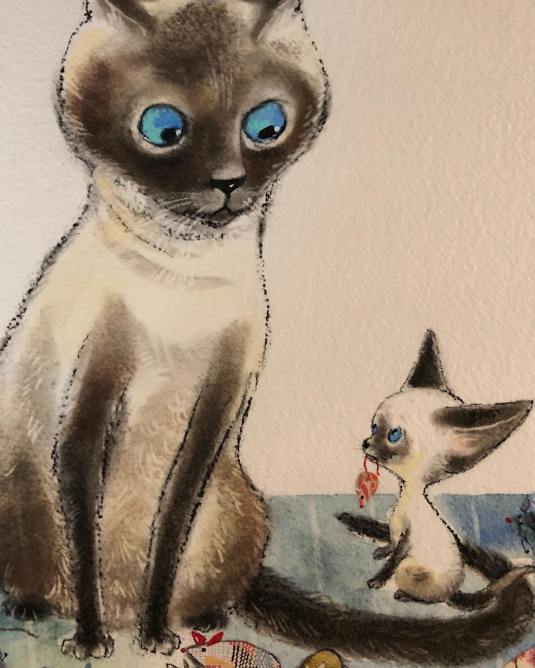
On a Cat

JByronSchachner copy

illustrator: J Byron Schachner


Lines from To A Cat
by Algernon Charles Swinburne

Stately, kindly, lordly friend,
      Condescend
Here to sit by me, and turn
Glorious eyes that smile and burn,
Golden eyes, love’s lustrous meed,
On the golden page I read.
All your wondrous wealth of hair,
     Dark and fair,
Silken-shaggy, soft and bright
As the clouds and beams of night,
Pays my reverent hand’s caress
Back with friendlier gentleness.
Dogs may fawn on all and some
     As they come;
You, a friend of loftier mind,
Answer friends alone in kind.
Just your foot upon my hand
Softly bids it understand.

Shedding Pounds

Once again, my body detoxes while I sleep!

jeannepoland's avatarThe Vibrant Channeled Creator

Inge&Jeanne01

shed 33 pounds!

8 hours of sleep (stress free)

and trust weighs nothing

View original post

How to find a friend…

sorry For What My Face said

Read faces; Ask these questions and LISTEN:

What excites you right now? This is a question that has a wide range of possible answers. It gives others the ability to give with a work-related answer, or talk about their kids, or their new boat, or basically anything that excites them.

What are you looking forward to? This question works for the same reason, but is more forward-looking than backward-looking, allowing others to choose from a bigger set of possible answers.

What’s the best thing that happened to you this year? Similar to the previous two, but reversed: more backward-looking than forward-looking. Regardless, it’s an open-ended question that gives others a wealth of answers to choose from.

Where did you grow up? This question dives into others’ backgrounds (but in a much less assertive and loaded way than “Where are you from?”) and allows them to answer with simple details from childhood or to engage in their story of how they got to where they are right now and what they’re doing.

What do you do for fun? This question steers the conversation away from work, unless of course they are lucky enough to do for work what they’d be doing for fun anyway. Even then, it’s understood as a non-work question and the most likely answers will probably establish non-work ties.

Who is your favorite superhero? This might seem random, but it’s one of my favorites. Occasionally, asking this question has led me to bond over the shared love of a character, but more often you’ll find a shared connection or two in the reason for why the other person chose that particular character … or why they’re not really into superheroes.

Is there a charitable cause you support? Another big, open-ended question (assuming they support at least one charitable cause). It’s important to define support as broader than financial donations, as support might be in the form of volunteering or just working to raise awareness. You’re also really likely to either find shared ground or find out about a cause you didn’t know about.

What’s the most important thing I should know about you? This one is effective for similar reasons as many of the above, plus it gives the broadest possible range from which they can choose. It can come off as a little forthright, so when to use it depends on a lot of contextual clues.

David Burkus is the best-selling author of three books, including Friend of a Friend, and Associate Professor of Leadership and Innovation at Oral Roberts University. For more information, visit his website.

Primaries

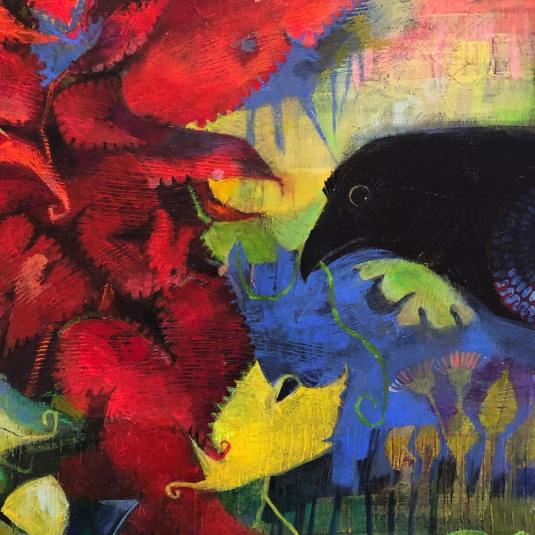
JByronSchachnerPrimaryConvolution

illustration by J Byron Schachner


primary colors

of red blue yellow

strut forward

standing boldly in the spotlight

asserting themselves

primary characters in every way!

yellow

coyotes-winter-yellowstone-161-5839

coyotes by David C Schultz


yellow is closest to white

the color of the snows of winter –

the closest to white fur

of coyotes –

which turns yellow

in the winter –

to stand out in the snow –

to glow gold in the light –

the blue light of winter, water and wonder.

ice and fire

iceberg-antarctica-166-4112

Antartica- during global warming


ice

 a slice of cold

freezes us


while


sun and core

burn to fry

our withered limbs


sigh…

tribe

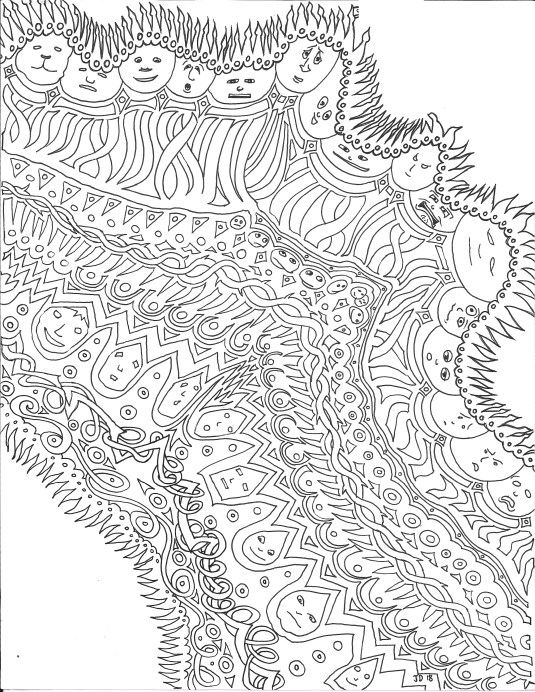
JohnDeLoca'sdesign

John DeLoca’s design

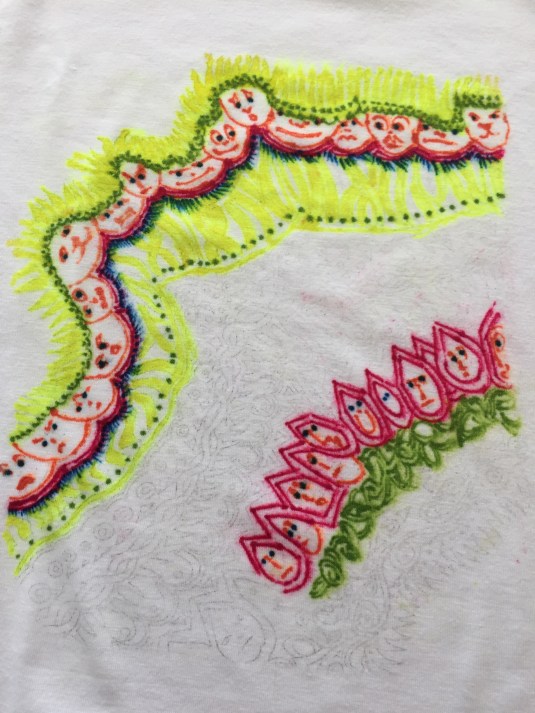
IMG_3369

Jeanne’s rendering with infused ink on T-shirt


cells we are

in red and green

opposites

from maid to queen

Previous Older Entries Next Newer Entries