
Italic calligraphy by John Stephens with ligatures and flourishes
There is another alphabet whispering from every leaf,
singing from every river,
shimmering from every sky.
Jeanne Poland's Poetry Blog
18 Apr 2020 Leave a comment
in flourishes, Poetry Tags: another alphabet, flourishes, Italic Calligraphy, John Stevens, ligatures, shimmering from every sky, singing from every river, whispering from every leaf
Italic calligraphy by John Stephens with ligatures and flourishes
There is another alphabet whispering from every leaf,
singing from every river,
shimmering from every sky.
17 Apr 2020 Leave a comment
in Poetry
this is life in Maine
An Ars Poetica poem
talks about the art of writing poetry,
presents the poet’s views on what a poem is
and how it should be written.
Tea in Maine
A poem is sound: Ruth Grierson plays violin.
A poem is memory: Scottish jigs & ballads;
A poem is taste: all kinds of music but rap!!!!!!
A poem is smell: while we sip English Tea
A poem is a stage: at the library;
A poem is a story: hear about:
the ceremonial burning
of old buildings that need replacement
the Fire of 1947;
that stopped when the fireball hit the sea!
the flames brought forth
the aspen, birch and new seeds that burst in the heat!
17 Apr 2020 Leave a comment
in cello, Poetry Tags: across my heart, cello, clapping of a few moist hands, Hauser, JSBach, peeling off long white chords, suite#2 in D Minor Prelude, Ted Kooser, the light in my hair, Weather Central

Youtube Link:
There’s Something About A Cello
Cellos are resonant. It feels to me as if the bow were playing
right across my heart rather than the strings. Talk about a cello in
your poem, or if you don’t love the sound of a cello, let your poem
speak about delight in another instrument.
Peeling a Potato
Pablo Casals should see me now,
bowing this fat little cello,
peeling off long white chords.
I am not famous like Pablo,
not yet. The amphitheater
of the kitchen sink is nearly empty.
As the notes reel out,
I hear only the hesitant clapping
of a few moist hands.
I am playing the solo variations
of J.S. Bach. Wonderfully,
I sweep with my peeler. See me lean
into the work, tight lipped,
the light in my hair. Inspiration
trickles over my handsome old hands.
Ted Kooser
in Weather Central
On Bach’s Cello Suite No. 2 in D Minor
Prelude
16 Apr 2020 Leave a comment
in daffodils, Poetry Tags: a crowd dancing in the breeze, daffodils, I wondered lonely as a child, my heart fills with pleasure, sister Dorothy, ten thousand, the best lines in the poem, the bliss of solitude, the flash upon the inward eye, wife Mary, William Wordsworth

I Wandered Lonely as a Cloud
by William Wordsworth
I wandered lonely as a cloud
That floats on high o’er vales and hills,
When all at once I saw a crowd,
A host, of golden daffodils;
Beside the lake, beneath the trees,
Fluttering and dancing in the breeze.
Continuous as the stars that shine
And twinkle on the milky way,
They stretched in never-ending line
Along the margin of a bay:
Ten thousand saw I at a glance,
Tossing their heads in sprightly dance.
The waves beside them danced; but they
Out-did the sparkling waves in glee:
A poet could not but be gay,
In such a jocund company:
I gazed—and gazed—but little thought
What wealth the show to me had brought:
For oft, when on my couch I lie
In vacant or in pensive mood,
They flash upon that inward eye
Which is the bliss of solitude;
And then my heart with pleasure fills,
And dances with the daffodils.
“I Wandered Lonely As A Cloud” by William Wordsworth. Public domain.
It was on this day in 1802 that William Wordsworth (books by this author) was walking home with his sister, Dorothy, and saw a patch of daffodils that became the inspiration for one of his most famous poems.
They were returning from a visit to their friends Thomas and Catherine Clarkson, who lived on the shore of Ullswater, the second largest lake in England’s lake district, a beautiful deep lake, nine miles long, surrounded by mountains.
Dorothy wrote in her journal: “When we were in the woods beyond Gowbarrow park we saw a few daffodils close to the water side. We fancied that the lake had floated the seeds ashore and that the little colony had so sprung up. But as we went along there were more and yet more and at last under the boughs of the trees, we saw that there was a long belt of them along the shore, about the breadth of a country turnpike road. I never saw daffodils so beautiful they grew among the mossy stones about and about them, some rested their heads upon these stones as on a pillow for weariness and the rest tossed and reeled and danced and seemed as if they verily laughed with the wind that blew upon them over the lake, they looked so gay ever glancing ever changing.”
William was impressed by the daffodils too, but William didn’t write anything about them for at least two years, maybe more. No one is sure when he wrote the poem “I wander’d lonely as a cloud,” but it was published in 1807. Not only did Wordsworth probably reference Dorothy’s journal for inspiration, but his wife Mary came up with two lines: “They flash upon that inward eye / Which is the bliss of solitude.” William said they were the best lines in the poem.
14 Apr 2020 Leave a comment
in gratitude for the media, Poetry Tags: apathy, corruption, cover the work being done, creates depression, Fixes, gratitude for the media, health care, helplessness, incompetence, major social crisis, not simply celebrate it, not violence, poverty, shshould not be painful to consume, stress, Tina Rosenburg

Tina Rosenburg
The key, she says, is to cover the work that is being done, not simply celebrate it. She contributes to a New York Times column called “Fixes,” in which she explores solutions to major social crises like health care and poverty.
She says: “We know that a steady diet of news about violence and corruption and incompetence does create in people: depression, apathy, learned helplessness, stress, all kinds of things. And it’s really bad for the news business. We are selling a product that people find painful to consume. I think anyone would tell you that that’s not a good business model.”
Please see: https://www.youtube.com/watch?v=Suf6BpY418
13 Apr 2020 Leave a comment
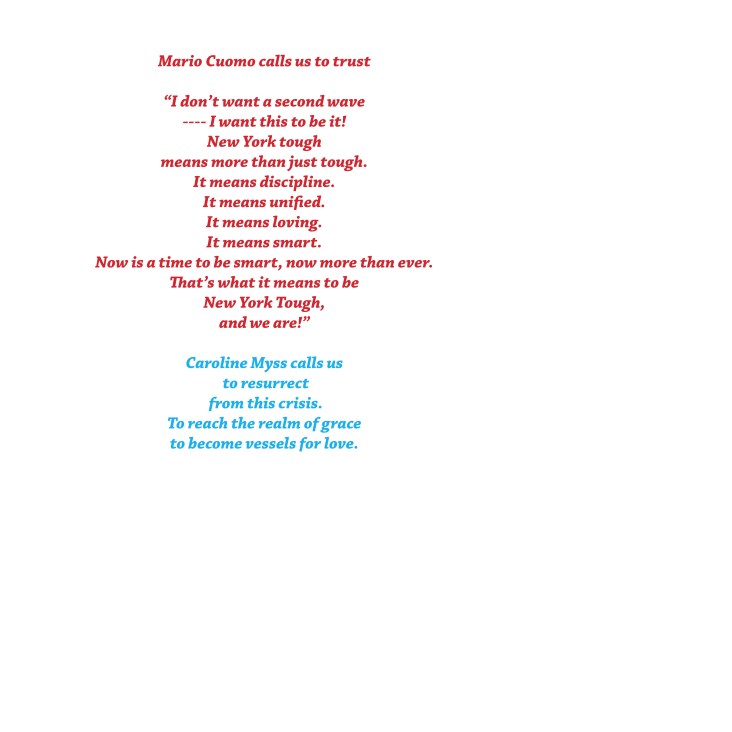
in calk of our leaders, Poetry Tags: call of our leaders, calls for trust, calls us to resurrect, Caroline Myss, discipline, loving, Mario Cuomo, smart, to become vessels for love, to reach the realm of grace, tough, unified

11 Apr 2020 Leave a comment
in Poetry
one of my favorite innocence poses of the grandchild

My struggle is to use the life in order to transcend it, to convert it into legend.Stanley Kunitz
Lady Marion courtesies
Her hand-me-downs
This fine day arrived.
Apparel takes a bow
For camera
And Grandma:
Author of colors
Fabrics, patterns
Costumes of the world.
Literature
Illustrations
Published:
The pages open
The glance
Submits to legend.
11 Apr 2020 Leave a comment
in Poetry
grew my nails
 Jeanne in superhero disguise
April 11, 2015
chutzpah:
a circus
animation.
intuition’s
quicksilver.
balance
centering
resting finish.
hiding
poop &
sweat.
breathing
smiles &
bows.
under the tent.
11 Apr 2020 Leave a comment
in A Drink of Water, Poetry Tags: A Drink of Water, across time, don't tellhim to use a glass, Jeffrey Harrison, my older brother, my son becomes my brother, natural, nineteen year old son, painting by Neil Waldman, Poems of Kindness, simple need, stream of cool water, the same water, two worlds, water dripping from his cheek, youth is flexible
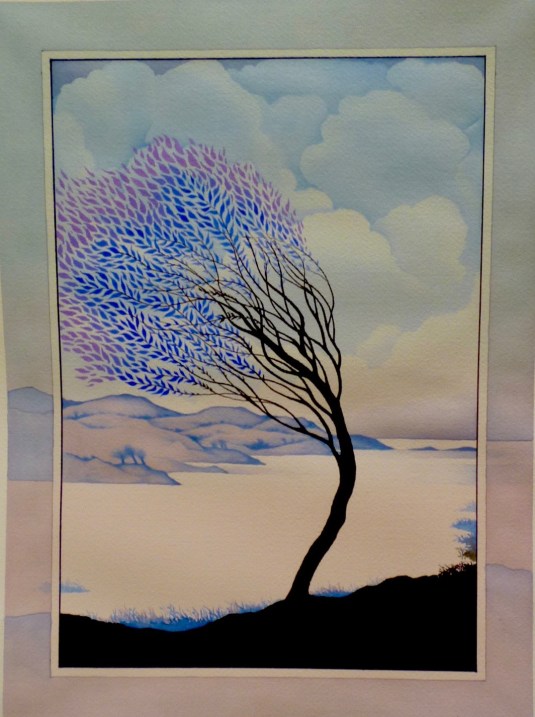
painting by Neil Waldman
youth is flexible
A Drink of Water
When my nineteen-year-old son turns on the kitchen tap
and leans down over the sink and tilts his head sideways
to drink directly from the stream of cool water,
I think of my older brother, now almost ten years gone,
who used to do the same thing at that age;
and when he lifts his head back up and, satisfied,
wipes the water dripping from his cheek
with his shirtsleeve, it’s the same casual gesture
my brother used to make; and I don’t tell him
to use a glass, the way our father told my brother,
because I like remembering my brother
when he was young, decades before anything
went wrong, and I like the way my son
becomes a little more my brother for a moment
through this small habit born of a simple need,
which, natural and unprompted, ties them together
across the bounds of death, and across time…
as if the clear stream flowed between two worlds
and entered this one through the kitchen faucet,
my son and brother drinking the same water.
Jeffrey Harrison
anthologized in Healing the Divide:
Poems of Kindness and Connection
edited by James Crews
10 Apr 2020 Leave a comment
in Poetry, silence of the trees Tags: a presence whose margins are our margins, bottomless ocean, But only God can make a tree, But the silence in the mind, deep of the psalm writer, draw nearer to such ubiquity, Joyce Kilmer, launch the armada, over our own fathoms, Poems are made by fools like me, remain still, RSThomas, silence of the trees, the silence we call God, Upon whose bosom snow has lain, watercolor by Neil Waldman, Who ultimately live with rain
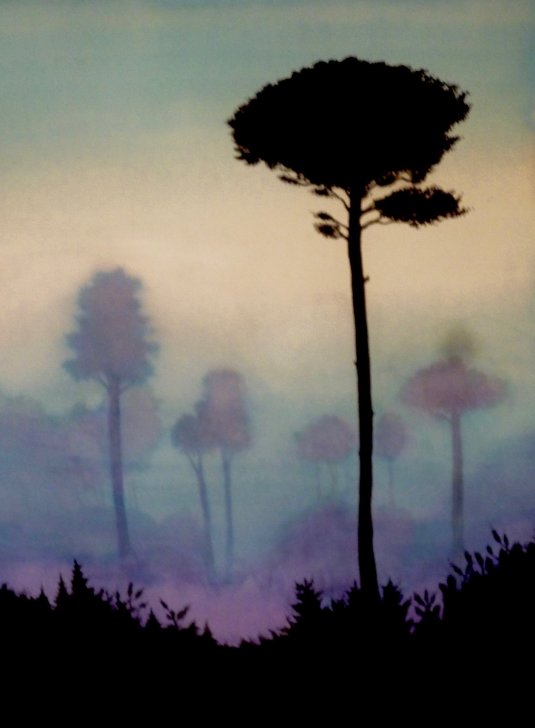
watercolor by Neil Waldman
Upon whose bosom snow has lain;
Who intimately lives with rain.
Poems are made by fools like me,
But only God can make a tree.
poem by Joyce Kilmer
But the Silence in the Mind
But the silence in the mind
is when we live best, within
listening distance of the silence
we call God. This is the deep
calling to the deep of the psalm-writer,
the bottomless ocean
we launch the armada of
our thoughts on, never arriving.
It is a presence, then,
whose margins are our margins;
that calls us out over our
own fathoms. What to do
but draw a little nearer to
such ubiquity by remaining still?
R.S. Thomas


 The Vibrant Channeled Creator