In 2014, I worked on a book of technology images

 atomic explosion
nuclear fusion
digital textures
galactic findings:
infused atomic power
rich psychic senses!
Jeanne Poland's Poetry Blog
15 Oct 2019 Leave a comment
in Poetry
In 2014, I worked on a book of technology images
atomic explosion
nuclear fusion
digital textures
galactic findings:
infused atomic power
rich psychic senses!
14 Oct 2019 Leave a comment
in Another genius in Cambridge Mass..., Poetry Tags: actor, Another genius in Cambridge Mass..., canoeist, crack shot, experimental poems, father:Edward a minister, first telephone, fly-fisherman, HIM and Her, image for e e cummings, in 1962 second most read poet, magnificently voiced, new Hampshire man, own grammar rules, ownsweetway, plumber, preacher, sailor, teacher, woodsman

image for e e cummings
It’s the birthday of E.E. Cummings , born Edward Estlin Cummings in Cambridge, Massachusetts (1894). His poems were experimental and he followed his own grammar rules, but they were about simple subjects — love, nature, children, sex — and people liked that. When he died in 1962, he was the second most read poet in the country, after Robert Frost.
His father, also named Edward, was a Harvard professor-turned-Unitarian minister, a well-known public figure. Cummings said, “My father is the principal figure of my earliest remembered life. […] His illimitable love was the axis of my being.” He described his father: “He was a New Hampshire man, 6 foot 2, a crack shot and a famous fly-fisherman & a firstrate sailor (his sloop was named The Actress) & a woodsman who could find his way through forests primeval without a compass & a canoeist who’d still paddle you up to a deer without ruffling the surface of a pond & an ornithologist & taxidermist & (when he gave up hunting) an expert photographer & an actor who portrayed Julius Caesar in Sanders Theatre & a painter (both in oils & watercolors) […] & a plumber who just for the fun of it installed his own waterworks & (while still at Harvard) a teacher with small use for professors […] a preacher who horribly shocked his pewholders by crying ‘the kingdom of Heaven is no spiritual roofgarden: it’s inside you’ & my father had the first telephone in Cambridge […] & my father was a servant of the people who fought Boston’s biggest & crookedest politician fiercely all day & a few evenings later sat down with him cheerfully at the Rotary Club & my father’s voice was so magnificent that he was called on to impersonate God from Beacon Hill (he was heard all over the Common).”
12 Oct 2019 Leave a comment
in Poetry Tags: campaigned on civil rights, Eleanor Roosevelt, Franklyn Delano Roosevelt, freedom in Hollywood, learn to live together, others think of you hadly at all, police state, taught International relations, Un-American activities, what happens when wife leads country..., woman is like a teabag
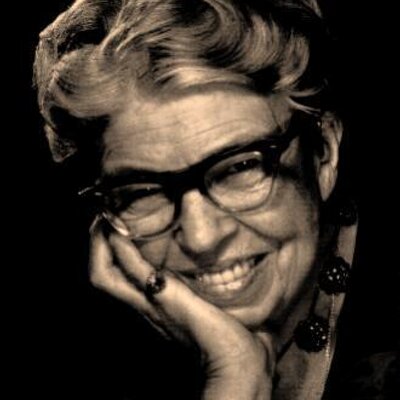
Eleanor Roosevelt
It’s the birthday of the longest-serving First Lady, Eleanor Roosevelt (books by this author), born in New York City (1884) who said, “A woman is like a tea bag. You never know how strong she is until she gets into hot water.”
She began a secret courtship with her cousin Franklin Delano Roosevelt. During World War I, she went off to Europe and visited wounded and shell-shocked soldiers in hospitals there.
Later, during her husband’s presidency, she campaigned hard on civil rights issues — not a universally popular thing in the 1930s and 1940s.
After FDR died in 1945, she moved from the White House to Hyde Park, New York, and taught International Relations at Brandeis University. As anti-communist witch-hunting began to sweep the U.S., she stuck up for freedom of association in a way that few Americans were brave or bold enough to do.
She chided Hollywood producers for being so “chicken-hearted about speaking up for the freedom of their industry.” She said that the “American public is capable of doing its own censoring” and that “the judge who decides whether what [the film industry] does is good or bad is the man or woman who attends the movies.”
She said that the Un-American Activities Committee was creating the atmosphere of a police state in America, “where people close doors before they state what they think or look over their shoulders apprehensively before they express an opinion.”
In 1947, a couple years before the McCarthy Era had reached full swing, she announced, “The Un-American Activities Committee seems to me to be better for a police state than for the USA.”
She once said, “We have to face the fact that either all of us are going to die together or we are going to learn to live together and if we are to live together we have to talk.”
And, “You wouldn’t worry so much about what others think of you if you realized how seldom they do.”
09 Oct 2019 Leave a comment
in Poetry Tags: a sweetness, Beatlemania, electric charge from bees, energy, George Harrison, God's finger, John Lennon, like honey, Linda Pastan, Paul McCartney, Quarrymen, Ringo Starr, sex ed, spark, Strawberry Fields

illustrator: Jeanne
Sex Education
by Linda Pastan
When a bee enters the plant’s electric field, a small electric charge develops … —Earth easy blog
I remember what happened the day we met.
Electricity, they call it, a spark
like the one that went from God’s finger
to Adam’s in the Sistine Chapel.
I always thought it was a metaphor,
but now I read that bees are led to pollen
by a flower’s electric force field,
not just by seductive reds and purples.
I remember how you looked at me,
how I looked back.
And spreading through my limbs
a sweetness, like honey.
“Sex Education” by Linda Pastan from Insomnia. © W. W. Norton 2015. Reprinted with permission
The Beatles are an energy field- penetrating us still!
Sixteen-year-old John started a band called the Quarrymen, and when they were playing at a church fundraiser, Paul McCartney heard them and came up to introduce himself. Soon, McCartney was part of the band, and the two teenagers started writing songs together. When John’s mother died in a car crash a year later, he and Paul McCartney became even closer, because Paul’s mother had died from cancer less than two years earlier.
In 1960, the group became the Silver Beatles, and soon, just the Beatles, but it wasn’t until 1962 that they ended up with the four band members who would become the band as we know them: Lennon, McCartney, George Harrison, and Ringo Starr.
The Beatles became a sensation; “Beatlemania” swept across Europe and the United States.
When his son Sean was born in 1975, Lennon retired from public life and spent five years staying home with his family. In November of 1980, he and his wife, Yoko, released an album called Double Fantasy, gave interviews, and considered touring again. But on December 8th, he was shot outside his apartment by a 25-year-old man named Mark David Chapman. Chapman was obsessed with J.D. Salinger’s novel Catcher in the Rye, and claimed that he thought of himself as Holden Caulfield, and that this would explain his actions — although he later admitted that Holden Caulfield would probably not have shot someone.
A few days after her husband’s murder, Yoko Ono asked for 10 minutes of silence to honor him, and people all over the world observed the silence, including a crowd of more than 100,000 people in Central Park. The area of Central Park between 71st and 74th streets was designated “Strawberry Fields,” a green space and peace garden in memory of John Lennon.
08 Oct 2019 Leave a comment
in imagination, Poetry Tags: a world at peace, be a dreamer, brotherhood of man, imagination, John Lennon, live as one, living for today, living in peace, no hunger, the world as one, tolerance

On this day in 1971, John Lennon released his second solo album, Imagine. The title track was the best-selling song of his solo career and was included on BMI’s list of the top 100 most-performed songs of the 20th century. Lennon said that he and Yoko Ono received a prayer book, which inspired him to write the song. He said: “The concept of positive prayer … If you can imagine a world at peace, with no denominations of religion — not without religion but without this my-God-is-bigger-than-your-God thing — then it can be true.”
The song’s call for peace and tolerance continues to resonate with people all over the world. Jimmy Carter said, “[I]n many countries … you hear John Lennon’s song ‘Imagine’ used almost equally with national anthems.”
The Beatles – Imagine Lyrics
Imagine there’s no heaven
It’s easy if you try
No hell below us
Above us only sky
Imagine all the people
Living for today…
Imagine there’s no countries
It isn’t hard to do
Nothing to kill or die for
And no religion too
Imagine all the people
Living life in peace…
You may say I’m a dreamer
But I’m not the only one
I hope someday you’ll join us
And the world will be as one
Imagine no possessions
I wonder if you can
No need for greed or hunger
A brotherhood of man
Imagine all the people
Sharing all the world…
You may say I’m a dreamer
But I’m not the only one
I hope someday you’ll join us
And the world will live as one
07 Oct 2019 Leave a comment
in Poetry
Apple orchids don’t do well with tiny wheels for avid mountain bikers!
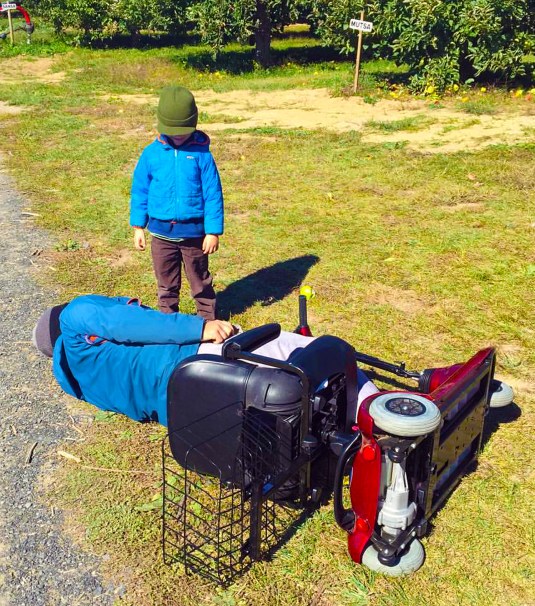
Owen tries to drive Mom’s scooter to pick apples…
.
iddy-biddy-bars
tiny wheels: wide turns required
biker’s paradox
07 Oct 2019 Leave a comment
in memories in the refrigerator, Poetry Tags: Afternoon Memory by Gary Soto, care of knee, cross legged chicken, doctor bills, fleck floating, foot going to sleep, Julie Rohan Zoch, linoleum blisters, magnets on the fridge, memories in the refrigerator, Mrs Butterworth, mustard is familiar, old age, spanish olives

Julie Rohan Zoch
Afternoon Memory
by Gary Soto
Sometimes I’ll look in the refrigerator
And decide that the mustard is vaguely familiar
, And that the jar of Spanish olives is new to me.
What’s this gathering? The butter
And salsa, the two kinds of tortillas
And, in back, the fat-waisted Mrs. Butterworth.
I’ll study the plate of cross-legged chicken,
And close the refrigerator and lean on the kitchen counter.
Is this old age? The faucet drips
. The linoleum blisters when you walk on it.
The magnets on the refrigerator crawl down
With the gravity of expired coupons and doctor bills.
Sometimes I’ll roll my tongue in my mouth.
Is this thirst or desire?
Is this pain
Or my foot going to sleep? I know the factory
Inside my stomach has gone quiet.
My hair falls as I stand. My lungs are bean plants
Of disappearing air. My body sends signals, like now:
A healthy fleck is floating across my vision.
I watch it cross. It’s going to attack a virus
On the right side of my body
And, later, travel down my throat to take care of knee
sour liver,Little latch of hurt. I swallow three times.
I have to help my body parts. Fellas, sour liver
And trusty kidney, I’m full of hope.
I open the refrigerator.
blow dart of bran,I’ve seen this stuff before. What’s this?
The blow dart of bran? Chinese ginger?
No, fellas, they’re carrots. The orange, I hear,
Is good for your eyes.
“Afternoon Memory” by Gary Soto from New and Selected Poems. © Chronicle Books, 1995
06 Oct 2019 Leave a comment
in fainting with shock, Poetry Tags: at 16 years of age, Bayridge, by the Bus Stop, chastity, experience life, fainting with shock, friend of family, jeanne paints on her ipad, Louis Jenkins, middle of the day, the social circle, The Speaker, Woodhaven

jeanne paints on her iPad
By the Bus Stop
I fainted when I stepped off the bus
at 16 years of age. My boyfriend, Ray, showed
up at the corner in Woodhaven, all the way from
Bayridge, in the middle of the day. We were so taken with each other.
But, I chose to enter the convent, and we continued in chastity
to be friends of families and the social circle. Later we met again,
and he advised me on my relationships with men.
Now he appears nightly in my dreams, at 79 years of age.
Imagination endures.
The Speaker
by Louis Jenkins
The speaker points out that we don’t really have much of
a grasp of things, not only the big things, the important
questions, but the small everyday things. “How many steps
up to your front door? What kind of tree grows in your
backyard? What is the name of your district representative?
What is your wife’s shoe size? Can you tell me the color of
your sweetheart’s eyes? Do you remember where you parked
the car?” The evidence is overwhelming. Most of us never
truly experience life. “We drift through life in a daydream,
missing the true richness and joy that life has to offer.” When
the speaker has finished we gather around to sing a few
inspirational songs. You and I stand at the back of the group
and hum along since we have forgotten most of the words.
Louis Jenkins, “The Speaker” from Just Above Water. Copyright © 1997 by Louis Jenkins. Used by permission of The Permissions Company, LLC on behalf Holy Cow! Press, http://www.holycowpress.org.
05 Oct 2019 Leave a comment
in Laughter and howl, Poetry Tags: bummer lamb, grimace, grunt, Helen Church Candee, howel, hunted deer, Laughter and howl, Maxine Kumin, nurture, orphaned kangaroo, paw prints, scratch, single mother, wils child

Nurture
by Maxine Kumin
From a documentary on marsupials I learn
that a pillowcase makes a fine
substitute pouch for an orphaned kangaroo.
I am drawn to such dramas of animal rescue.
They are warm in the throat. I suffer, the critic proclaims,
from an overabundance of maternal genes.
Bring me your fallen fledgling, your bummer lamb,
lead the abused, the starvelings, into my barn.
Advise the hunted deer to leap into my corn.
And had there been a wild child—
filthy and fierce as a ferret, he is called
in one nineteenth-century account—
a wild child to love, it is safe to assume,
given my fireside inked with paw prints,
there would have been room.
Think of the language we two, same and not-same,
might have constructed from sign,
scratch, grimace, grunt, vowel:
Laughter our first noun, and our long verb, howl.
“Nurture” by Maxine Kumin from Selected Poems: 1960-1990. W. W. Norton, © 1997. Reprinted with the permission of the estate of Maxine Kumin.
It’s the birthday of the author Helen Churchill Candee, née Hungerford, in New York City (1858). One of her early books was a how-to guide, How Women May Earn a Living (1900). Her husband, Edward Candee, was abusive, and she eventually took the children and left him. As a single working mother, she wanted to make sure that other women could find ways to support themselves without relying on men. She wrote books on decorative arts, and also published a novel, An Oklahoma Romance, in 1901.
Once she was established as a writer, Candee moved to Washington, D.C., and became one of the first professional interior decorators; several high-powered politicians, including Theodore Roosevelt, were her clients.
She was in Europe early in 1912 when she received word that her son, Harold, had been injured in an accident. Naturally, she wanted to return home as soon as possible. From Cherbourg, she boarded a brand new luxury liner, the RMS Titanic, bound for New York. When the ship struck an iceberg near midnight on April 14 and began to sink, Candee boarded Lifeboat Six, under the command of quartermaster Robert Hitchens. She tried to persuade him to go back after the ship went down, to search for any survivors, but he refused. She wrote a dramatized account of the voyage for Collier’s Weekly magazine, about an unnamed man and woman. The story, called “Sealed Orders,” included a romantic sunset visit to the bow of the great ship, and it may have inspired parts of James Cameron’s movie Titanic (1997).
04 Oct 2019 Leave a comment
in Far from the kisses, Poetry Tags: Cosei Kawa illustration, Ellen Bass, extra pounds, Far from the kisses, kissed and kissed, lavish kisses like the ocean, lonely, middle aged body, mother giving birth, neither was young, smile of wonder, snapped out of a coma, taste the kisses, tilting our heads up

Gate C22 by Ellen Bass
At gate C22 in the Portland airport
a man in a broad-band leather hat kissed
a woman arriving from Orange County.
They kissed and kissed and kissed. Long after
the other passengers clicked the handles of their carry-ons
and wheeled briskly toward short-term parking,
the couple stood there, arms wrapped around each other
like he’d just staggered off the boat at Ellis Island,
like she’d been released at last from ICU, snapped
out of a coma, survived bone cancer, made it down
from Annapurna in only the clothes she was wearing.
Neither of them was young. His beard was gray.
She carried a few extra pounds you could imagine
her saying she had to lose. But they kissed lavish
kisses like the ocean in the early morning,
the way it gathers and swells, sucking
each rock under, swallowing it
again and again. We were all watching—
passengers waiting for the delayed flight
to San Jose, the stewardesses, the pilots,
the aproned woman icing Cinnabons, the man selling
sunglasses. We couldn’t look away. We could
taste the kisses crushed in our mouths.
But the best part was his face. When he drew back
and looked at her, his smile soft with wonder, almost
as though he were a mother still open from giving birth,
as your mother must have looked at you, no matter
what happened after—if she beat you or left you or
you’re lonely now—you once lay there, the vernix
not yet wiped off, and someone gazed at you
as if you were the first sunrise seen from the Earth
. The whole wing of the airport hushed,
all of us trying to slip into that woman’s middle-aged body,
her plaid Bermuda shorts, sleeveless blouse, glasses,
little gold hoop earrings, tilting our heads up.
Ellen Bass, “Gate C22″ from The Human Line. Copyright © 2007


 The Vibrant Channeled Creator