family head may be gentle
gently covered by lace;
family way may face forward
gently asserting its face;
naval may push out gently
or point gently into its bud;
waiting to burst forth with
matriarch’s majesty, matriarch’s untiring grace.
Jeanne Poland's Poetry Blog
21 Sep 2015 Leave a comment
in matriarch Tags: asserting its face, burst forward, face forward, family head, gentle, Matriarch, matriarch's majesty, matriarch's untiring grace, naval may push out, photo of Kelly Helmsby by Frank Scotti
family head may be gentle
gently covered by lace;
family way may face forward
gently asserting its face;
naval may push out gently
or point gently into its bud;
waiting to burst forth with
matriarch’s majesty, matriarch’s untiring grace.
20 Sep 2015 Leave a comment
in inventions Tags: Advancement of Science, Darwin, Faraday, fish eye lens, Foucault, Howe, inventions, iPhone6+, macro as mites, macro lens, McCormick, photo taken with a fish eye lens at the Apple Store, specs, wide angle lens
lens to see as fish
lens to see macro as mites
wide angles to specs
The American Association for the Advancement of Science was established in Philadelphia on this date in 1848. Its stated purpose was to “procure for the labors of scientific men increased facilities and a wider usefulness.”
The term “scientist” had been coined in English just 15 years earlier, and all over the world scientists were making important new discoveries and formulating new ideas. Europe tended to be the center for the great theorists of science — in the year 1848, Léon Foucault set up his first rudimentary pendulum to demonstrate the Earth’s rotation; Darwin was at work on his theory of evolution; Michael Faraday was at the height of his work on electromagnetism. But America was cut off from Europe, and it was hard to compete with the scientific community there. Instead, there was an interest in invention and science that supported industry. Just four years earlier, the first telegraph line was installed, stretching from Baltimore to Washington, D.C. Trains were popping up all over the country, and in the year 1848, four times as many train tracks were laid as in 1847. In 1845, Elias Howe had invented the mechanical sewing machine. The inventor Cyrus McCormick had sold the patent for his McCormick Reaper in the 1830s.
19 Sep 2015 Leave a comment
in Autumn Tags: by John Keats, illustration by Plowarski, maturing sun, mists, moss'dcottage-trees, Ode to Autumn, ripeness to the core
Season of mists and mellow fruitfulness,
Close bosom-friend of the maturing sun;
Conspiring with him how to load and bless
With fruit the vines that round the thatch-eves run;
To bend with apples the moss’d cottage-trees,
And fill all fruit with ripeness to the core”
John Keats
18 Sep 2015 1 Comment
in The Leaves Will Turn Color Tags: How much I can bear, My cheeks will turn spare, My feet will grow tender, No wonder I'll wonder, the boys will grow hair, the couples will pair, the girls'breasts will double, The Leaves Will Turn Color
The leaves will turn color
The boys will grow hair;
The girls’ breasts will double
The couples will pair.
My feet will grow tender
My cheeks will turn spare
No wonder I’ll wonder
How much I can bear.
17 Sep 2015 Leave a comment
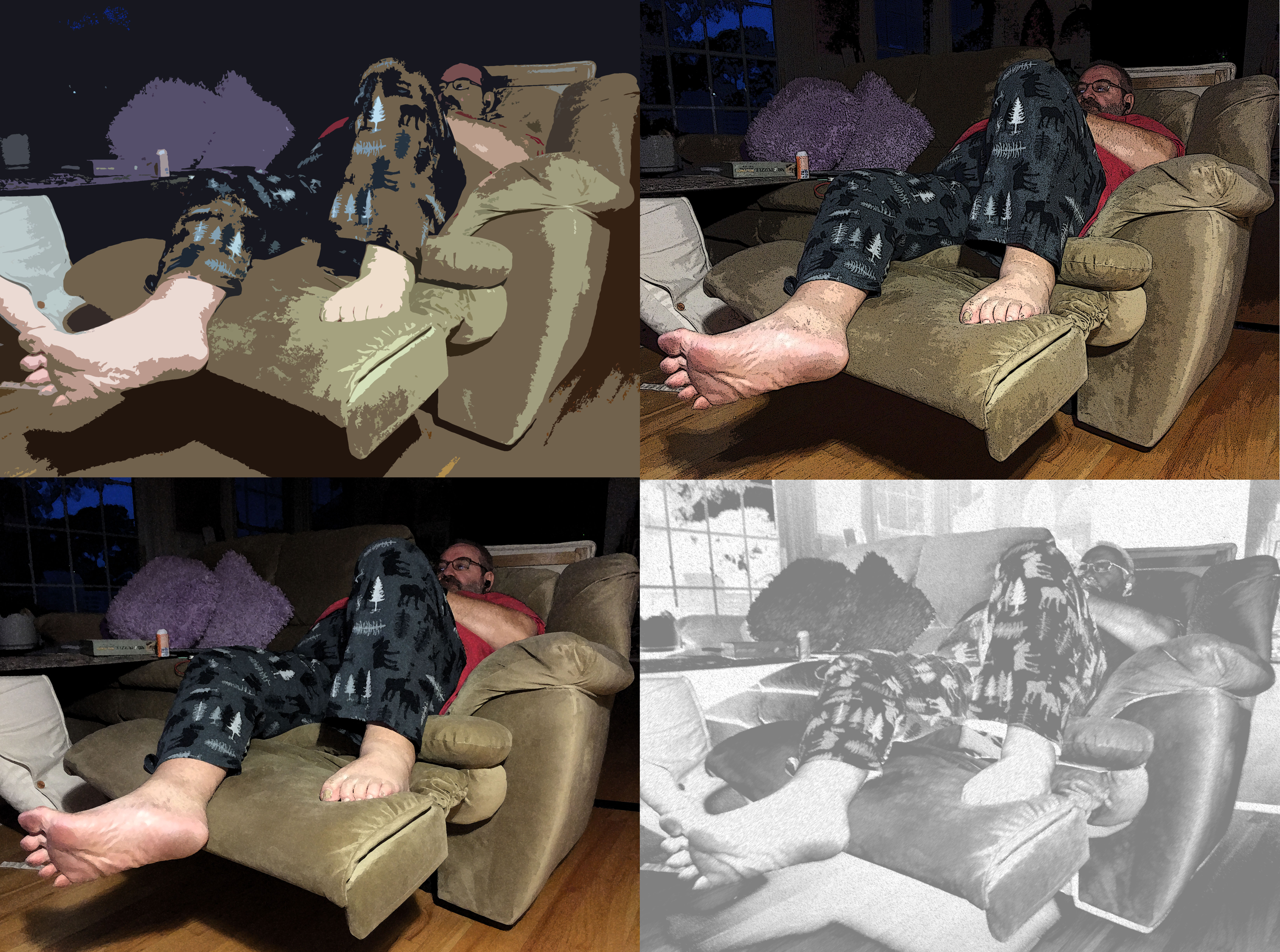
in Filters Tags: bas relief, Don-feet first, filters, four filters, geatured, Highlights, illustrations, lines, outline, poster, reclining Donald, shadows, watercolor
four illustrations
lines-highlights-shadows-gestured
reclining Donald
16 Sep 2015 1 Comment
in Curious Tags: Curious, Fifi to George, Hamburg Zoo to Paris, illustrations, Margret Waldstein, monkey manuscript, Nazis, Reyersbach to HA Rey
From Fifi to George
From Hamburg Zoo to Paris
From Reyersbach to
HA Rey
Today is the birthday of H.A. Rey (books by this author), born Hans Augusto Reyersbach in Hamburg, Germany (1898). He grew up near the Hagenbeck Zoo, and spent many happy hours watching and drawing the animals, and learning to imitate their sounds. When he was in his 20s, he moved to Rio de Janeiro, changed his last name to “Rey” because it was easier for Brazilians to pronounce, and went to work selling bathtubs.
It was in Rio that he was reunited with Margret Waldstein, a young artist he’d met back in Hamburg, when Margret was still a girl. She convinced him to leave the bathtub trade and together they opened an advertising agency. They were married in Brazil in 1935. They went to Europe on their honeymoon and decided to move back there, but couldn’t return to Germany because they were both Jews, and by this time the Nazis were in power. The Reys settled in Paris instead, and began collaborating on children’s books, with Margret writing the copy and Hans providing the illustrations.
They were living in Paris when the Second World War broke out. “It seems ridiculous to be thinking about children’s books,” Rey wrote to a friend. “[But] life goes on, the editors edit, the artists draw, even during wartime.” One of their collaborations, Raffy and the Nine Monkeys (1939), is about a lonely giraffe who opens her home to a family of monkeys. The youngest monkey was named Fifi, and he was always getting into scrapes; the Reys liked him so much, they decided to write a book that was just about him.
The Reys were at work on their Fifi book when they found out that the Nazis were going to invade Paris. Rey hastily built two bicycles out of spare parts; he and Margret gathered up a very few belongings — including their manuscript — and left the city just two days before the Nazis invaded, funded by the advance they had received for The Adventures of Fifi. They cycled 75 miles in two days, staying in farmhouses and barns. At one point, they were stopped by an official, who thought they might be German spies. He searched their bag, found the monkey manuscript, and released them. The Reys crossed Spain and Portugal, eventually making their way to Lisbon; from there, they sailed to Brazil, where they made arrangements to move to the United States.
They finally arrived in New York City four months after they’d left Paris, and moved to Greenwich Village. Within a week, they had found a publisher for their monkey book, but the publisher thought “Fifi” was a strange name for a boy monkey, so they changed his name. Curious George was published in 1941, and the Reys wrote and illustrated six more stories about him — stories like Curious George Rides a Bike (1952) and Curious George Goes to the Hospital (1966). Each book begins the same way: “George was a good little monkey, but he was always very curious.”

15 Sep 2015 Leave a comment
in Prestige Tags: but blend me in with the sanctuary of nature, cross himself, Ivan Pavlov, laboratory, medical student, naturalist, old woman in an almshouse, outside a church, physician, Put me not on a pedestal, Think about it!
Ivan Pavlov
One day, walking to his laboratory,
he saw a medical student cross himself outside a church.
“Think about it!” Pavlov told his colleagues.
“A naturalist, a physician, but he prays like an old woman in an almshouse!”
14 Sep 2015 Leave a comment
in Monochromatic Tags: monochromatic, photo by Jen Hooks, purrs its shadows and highlights, softly licks your face