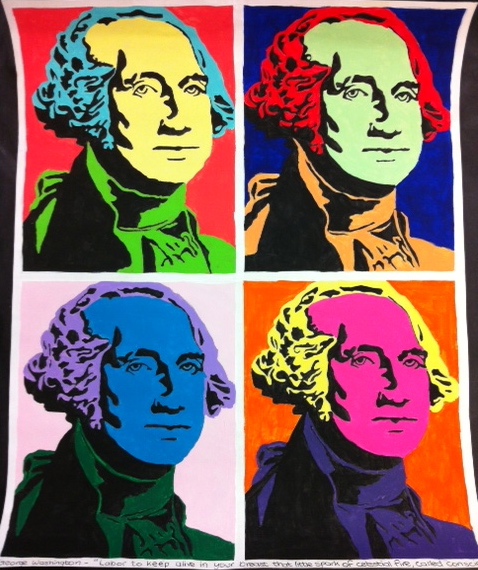
It was on this day in 1791 that the Bill of Rights was adopted by the United States, becoming the most sacred and debated laws in the history of our country. One of the people most responsible for the content of the Bill of Rights was a man named George Mason, who might not have even been a part of the process if he hadn’t been a lifelong friend of George Washington’s. He was a wealthy landowner in Virginia, and he liked to debate political ideas, but he wasn’t interested in politics because he shied away from public life.
Then, when the Revolutionary War broke out and George Washington was named Commander of the Continental Army, George Mason reluctantly took over his friend’s seat on the Virginia legislature. When the Virginia legislators held a convention to reorganize their state government, George Mason arrived late and found himself assigned to the committee to write the new state constitution.
So it was only by chance that Mason wound up writing Virginia’s “Declaration of Rights.” Mason had read the philosopher John Locke as a young man, and he shared Locke’s idea that all people are born with certain rights, and that government’s purpose should be to protect those rights. And George Mason believed that the best way to protect those rights would be to list them in the constitution itself. Virginia’s “Declaration of Rights,” was the first time in modern history that a government specified the absolute rights of individuals.
While George Mason was working on Virginia’s “Declaration of Rights,” he took under his wing a 25-year-old legislator named James Madison. Madison was deeply influenced by Mason’s ideas about freedom, and he passed them along to his friend Thomas Jefferson.
Mason mostly sat on the sidelines during the rest of the Revolutionary War, but after the war he was asked to participate in the Constitutional Convention. The trip from his home in Virginia to Philadelphia was the greatest distance he ever traveled, and it was a trip he quickly began to regret. He found that he disagreed with the other delegates on numerous issues, especially slavery, which he thought should be outlawed in the new constitution.
But more than anything, George Mason fought for the inclusion of a list of rights in the national constitution, just as he had written it into the Virginia Constitution. But when he brought his idea for a bill of rights to a vote, it failed by a wide margin. And so, when it came time to sign to new U.S. Constitution, George Mason was one of the only men there who refused. His decision created quite a stir, and it even ruined his lifelong friendship with George Washington. The two men never visited each other again.
But Mason hoped that his protest would encourage an eventual passage of a bill of rights, and it was ultimately his former protégé, James Madison, who made the Bill of Rights a reality. Madison introduced the Bill of Rights into the first session of Congress in 1789, and he used Virginia’s Declaration of Rights as the model. Madison originally supported the adoption of 17 amendments, which was eventually trimmed to 12, of which 10 were adopted, including the freedom of religion, freedom of speech, the right to bear arms, the right to privacy, and the right to a fair trial. George Mason died in 1792, a year after those freedoms and rights became law. (written by Garrison Keillor)
freedom of religion
freedom of speech
the right to bear arms
the right to privacy
the right to a fair trial


 The Vibrant Channeled Creator