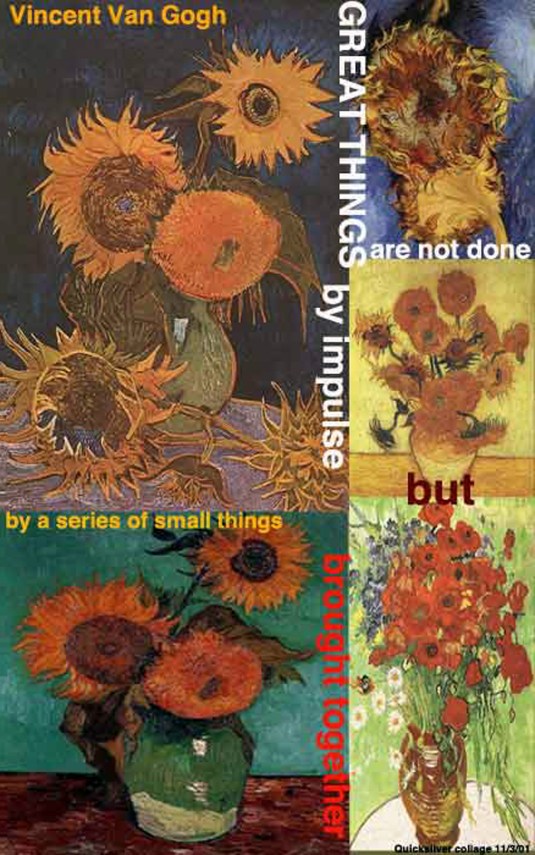
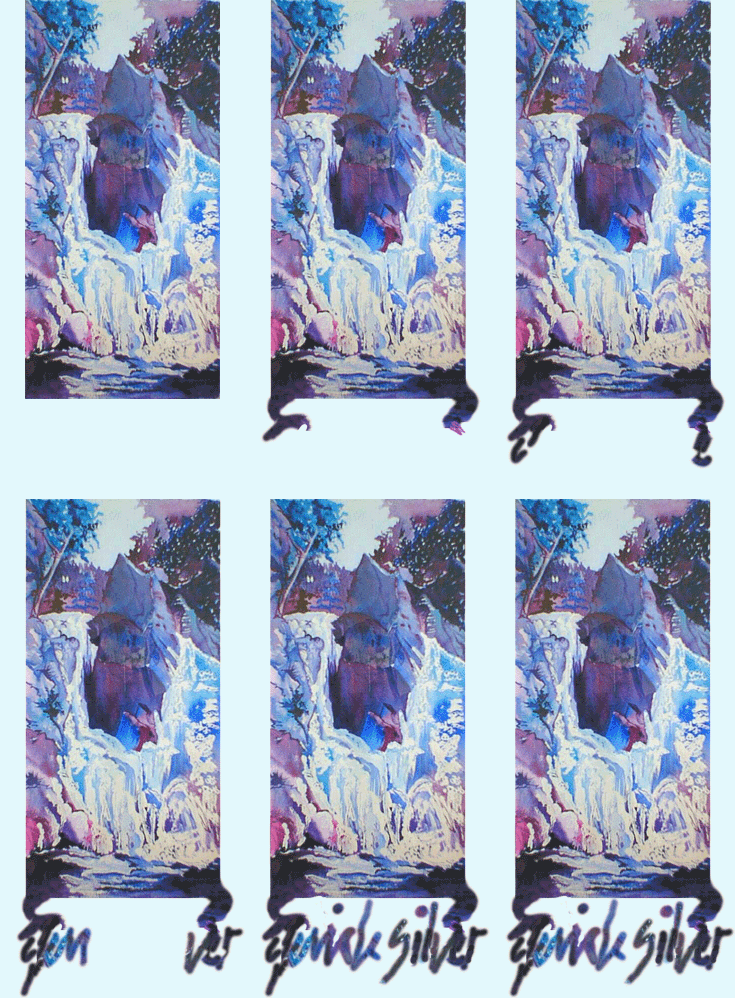
collage by Jeanne Poland (Quicksilver)
Vincent Van Gogh
March 30 is the birthday of the artist who wrote, “To do good work, one must eat well, be well housed, have one’s fling from time to time, smoke one’s pipe, and drink one’s coffee in peace”: Vincent van Gogh, born in Groot-Zundert, Holland, in 1853. Not much is known about his childhood, except that he was one of six children, a quiet boy, not especially drawn to artistic pursuits. He worked for a time in an art gallery in The Hague as a young man, then left to follow in his clergyman father’s footsteps as a sort of missionary to the poor. His behavior was erratic, but his family supported him as best they could. And while he didn’t last too long as an evangelist, he felt a kinship with the working classes — an affinity demonstrated again and again in his painting.
It was his brother Theo who urged Vincent to become an artist. Vincent had never had any formal training, nor displayed any overt talent, and he was doubtful about his chances for success, as were his parents. But Theo was persistent, and he would prove to be Vincent’s unfailing source of financial, emotional, and artistic support. Vincent taught himself to draw, and later took lessons. By 1886, he moved to Paris to live with Theo, and discovered that the muted palette he had used in his early work was woefully out of date. He adapted without too much trouble to the more vibrant hues of the Impressionists and Post-Impressionists, and it wasn’t long before he began to view color as the chief conveyer of emotion, even using it to illustrate abstract themes.
In 1888, he moved to the south of France, to Arles, in search of light and sun, hoping to form an artists’ colony with his friend Paul Gauguin. He began painting sunflowers to decorate Gauguin’s bedroom, and later, Gauguin would write of their time together: “In my yellow room, sunflowers with purple eyes stand out against a yellow background; the ends of their stalks bathe in a yellow pot on a yellow table. In one corner of the painting, the painter’s signature: Vincent. And the yellow sun, coming through the yellow curtains of my room, floods all this flowering with gold, and in the morning, when I wake up in my bed, I have the impression that it all smells very good. Oh yes! he loved yellow, did good Vincent, the painter from Holland, gleams of sunlight warming his soul, which detested fog. A craving for warmth. When the two of us were together in Arles, both of us insane, and constantly at war over beautiful colors, I adored red; where could I find a perfect vermilion? He, taking his yellowest brush, wrote on the suddenly purple wall: I am whole in spirit. I am the Holy Spirit.”
He wrote to Theo constantly from Arles, describing the landscape and his work in vivid terms. In 1888, he described his work on his painting “Night Café”: “I have tried to express the idea that the café is a place where one can destroy oneself, go mad, or commit a crime. In short, I have tried, by contrasting soft pink with blood-red and wine-red, soft Louis XV-green and Veronese green with yellow-greens and harsh blue-greens, all this in an atmosphere of an infernal furnace in pale sulphur, to express the powers of darkness in a common tavern.”
Van Gogh committed himself to an asylum in 1888. His behavior is consistent with what we now call manic depression or bipolar disorder, and he also suffered seizures due to temporal lobe epilepsy. He worked at an incredible pace during this time, although painting for long stretches was difficult for him, and he produced “Starry Night,” one of his most famous works. Two years later, he left the asylum but his frenetic pace continued, and he produced a painting almost daily. He believed himself a failure, although he never gave up hope of success; he wrote to Theo: “What am I in the eyes of most people — a nonentity, an eccentric, or an unpleasant person — somebody who has no position in society and will never have; in short, the lowest of the low. All right, then — even if that were absolutely true, then I should one day like to show by my work what such an eccentric, such a nobody, has in his heart.” He walked out one July afternoon in 1890 and shot himself, dying of the wound two days later. Theo died six months later, and the two are buried side by side in Auvers-sur-Oise.






 The Vibrant Channeled Creator