A Debate between Keanu Reeves and Elon Musk
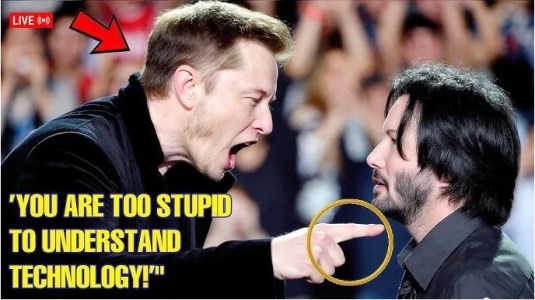
Keanu Reeves is known for his wisdom, humility, and deep understanding of life beyond Hollywood. In this powerful debate, Keanu Reeves goes head-to-head with Elon Musk in a conversation that challenges the future of AI, creativity, and human connection. As the discussion unfolds, Keanu Reeves delivers a response so profound that it leaves the audience in absolute shock.
Keanu Reeves stepped onto the stage with his characteristic quiet confidence. Across from him sat Elon Musk, the tech billionaire famous for his audacious claims and unapologetic vision for the future. The auditorium buzzed with anticipation, knowing this would not be a typical interview, but rather a pivotal debate about artificial intelligence (AI), creativity, and the future of humanity.
“I’m a bit surprised you agreed to this, Keanu,” Musk began, his tone laced with condescension. “AI is the future. Hollywood is nostalgia.”
Without missing a beat, Keanu replied, “Nostalgia reminds us what it means to be human. Can AI do that?”
The audience murmured appreciatively. Musk, momentarily caught off guard, quickly recovered. “AI already creates scripts, actors, and music. Soon, studios won’t need people. Why watch a real actor who ages when you can have a flawless digital version?”
Unfazed, Keanu leaned forward slightly. “Elon, have you ever watched a sunset? You can replicate it perfectly digitally, but does that mean you’ve truly experienced it? Real presence is something AI can’t replicate. Art, stories, and humanity itself are irreplaceable.”
The audience erupted in applause, visibly resonating with Reeves’s sentiment. Musk, clearly irritated, retorted sharply, “AI isn’t just replicating experiences; it’s improving them. Future movies will be scientifically perfected, precisely predicting audience desires. Humans can’t compete.”
Calmly, Keanu posed a thoughtful counter-question: “Then why do people still attend live concerts or Broadway shows when AI could theoretically perfect these experiences? People crave genuine connections that technology simply can’t replicate.”
Musk shifted in his seat, visibly uncomfortable as Keanu addressed the audience directly. “If you believe human creativity—the raw, imperfect beauty of real art—will always matter, let us know right now.”
Immediately, the live stream exploded with support, revealing overwhelming agreement with Reeves’s stance. Musk, cornered but defiant, persisted, “You’re missing the big picture. AI is efficiency, progress, survival. Humans are slow, emotional, flawed. AI isn’t.”
With poised clarity, Keanu replied, “Do you think intelligence is about replacing humans or helping them? The real question isn’t whether AI can replace us, but whether we should let it.”
The crowd again burst into applause. Musk, for the first time, seemed at a loss. Keanu’s message was penetrating deeper than he anticipated, resonating profoundly with the audience.
Desperate to regain control, Musk challenged, “AI is cheaper, faster, doesn’t age or demand royalties. Studios care about profit, not unpredictability. What happens when AI-generated movies earn more than those with real actors?”
Reeves paused thoughtfully before responding, “If AI-generated actors are truly superior, why haven’t they already replaced us entirely? Why do studios still choose humans? Because perfection isn’t what makes us connect—flaws do. Genuine performances aren’t memorable for technical precision but for their authenticity.”
Keanu then asked Musk directly, “If AI is so superior, why do humans still surprise each other? Why do we fall in love, laugh unexpectedly, or cry at predictable movie endings? Because we are unpredictable, something no AI can truly understand.”
The audience, captivated, roared in approval. Musk, increasingly frustrated, activated a massive screen behind them displaying a flawless AI-generated short film featuring a digitally recreated Keanu Reeves.
“This,” Musk declared triumphantly, “was produced entirely by AI in under 24 hours. No actors, no costly sets, just pure technology. How can you compete with this?”
The audience held its breath, waiting for Reeves’s response. He smiled calmly, unfazed by the display. “Will anyone here remember this AI-generated scene tomorrow? It looks perfect, but it’s empty. The greatest films aren’t remembered because they’re flawless—they’re remembered because they resonate. AI can mimic appearances, but it can’t replicate the soul.”
The audience erupted once again, sensing the truth in his words. Musk, increasingly unsettled, questioned Keanu’s qualifications. “You’re an actor, not an engineer. What gives you the right to debate AI’s future?”
With composed authority, Keanu replied, “I don’t need to be an engineer to understand humanity. I just need to be human.”
The auditorium exploded into applause, definitively shifting in Keanu’s favor. Reeves then dropped a revelation that left Musk visibly stunned: “For the past five years, I’ve invested in AI—not to replace humans, but to empower them. While you create AI to replace people, I create AI to protect creativity.”
The crowd went wild, realizing Keanu wasn’t just defending creativity philosophically; he was actively shaping its future. Musk, realizing he’d lost control, attempted a final comeback, arguing that convenience and efficiency ultimately dictate human behavior.
Keanu shook his head gently, “Throughout history, people have thought books, theaters, and live performances would disappear. Yet they’re still here because humans inherently value meaning over mere convenience. Technology doesn’t erase meaning; it makes us fight harder for it.”
The crowd stood, roaring in agreement. Keanu turned to address them directly, “This debate isn’t about AI. It’s about deciding who controls our future—those who want to replace humanity or those who want to empower it.”
Reeves closed with a rallying cry, “If you believe in human creativity and the right to shape our future, join this fight. The future isn’t dictated by technology; it belongs to those who choose it.”
Elon Musk, visibly shaken, remained silent as Reeves left the stage to deafening applause. The debate had ended decisively, marking a significant moment in the conversation about AI and humanity. Keanu Reeves hadn’t just challenged a powerful tech titan; he had reminded the world of something critical—that the power to shape our future remains, and should always remain, human.
Here I will try to see what really happened here!
The contrast between Keanu Reeves and Elon Musk in this debate can be framed as the difference between humanistic wisdom and cold, utilitarian logic.
Keanu Reeves: The Guardian of Human Creativity
Reeves embodies a deeply human philosophy, emphasizing authenticity, imperfection, and emotional connection as the core of what makes art, creativity, and human life meaningful. His perspective resonates with a compassionate, soulful approach, rooted in a belief that technology should serve and elevate humanity, not replace it. He represents the philosopher-artist, a figure who values the spiritual and emotional depth of human experience over sheer efficiency or financial gain.
Elon Musk: The Pragmatic Technocrat
Musk, on the other hand, represents the machine-driven futurist, someone obsessed with optimization, control, and efficiency. His vision prioritizes technological progress over emotional depth, where human unpredictability is seen as an obstacle rather than an asset. His admiration for figures like Nietzsche or certain authoritarian thinkers suggests an Ubermensch mindset, where superiority is defined by power and intelligence rather than empathy and wisdom. His approach to AI, automation, and even business strategy reflects a mechanistic view of human society, where individuals are either useful components or obsolete relics.
Human Warmth vs. Cold Calculation
Reeves’ philosophy represents the warmth of human greatness, where true value is found in art, emotion, connection, and imperfection. Musk’s mindset, by contrast, embodies a dry, mechanical approach, where people are secondary to technological supremacy. This almost technocratic reductionism can be seen as eerily similar to past ideologies that devalued human individuality in favor of grand, impersonal visions of the future.
In essence, the contrast is between humanistic brilliance and a dystopian, efficiency-obsessed mentality—between someone who champions the soul of humanity and someone who sees humans as inefficiencies to be managed or even eliminated.
Here is the original link from Hot News Fandom:
UFC commentator Joe Rogan calls for major rule change after accusing fighter of ‘clearly cheating’ at UFC 314








 The Vibrant Channeled Creator